

Disclaimer: The opinions expressed by our writers are their own and do not represent the views of U.Today. The financial and market information provided on U.Today is intended for informational purposes only. U.Today is not liable for any financial losses incurred while trading cryptocurrencies. Conduct your own research by contacting financial experts before making any investment decisions. We believe that all content is accurate as of the date of publication, but certain offers mentioned may no longer be available.

Strategy's business model has come under a barrage of harsh criticism from experts. Well-known analyst Charles Edwards openly called Michael Saylor's strategy a "ticking time bomb" that fully depends on the continuous growth of Bitcoin's price and risks exploding during a prolonged market decline.
Fresh financial data as of the end of June 2026 partly confirms the fears. Right now, Strategy holds 847,363 BTC on its balance sheet, valued at $53.1 billion. However, because of the high average purchase price of $75,646, the company's unrealized paper loss has already exceeded $11 billion.
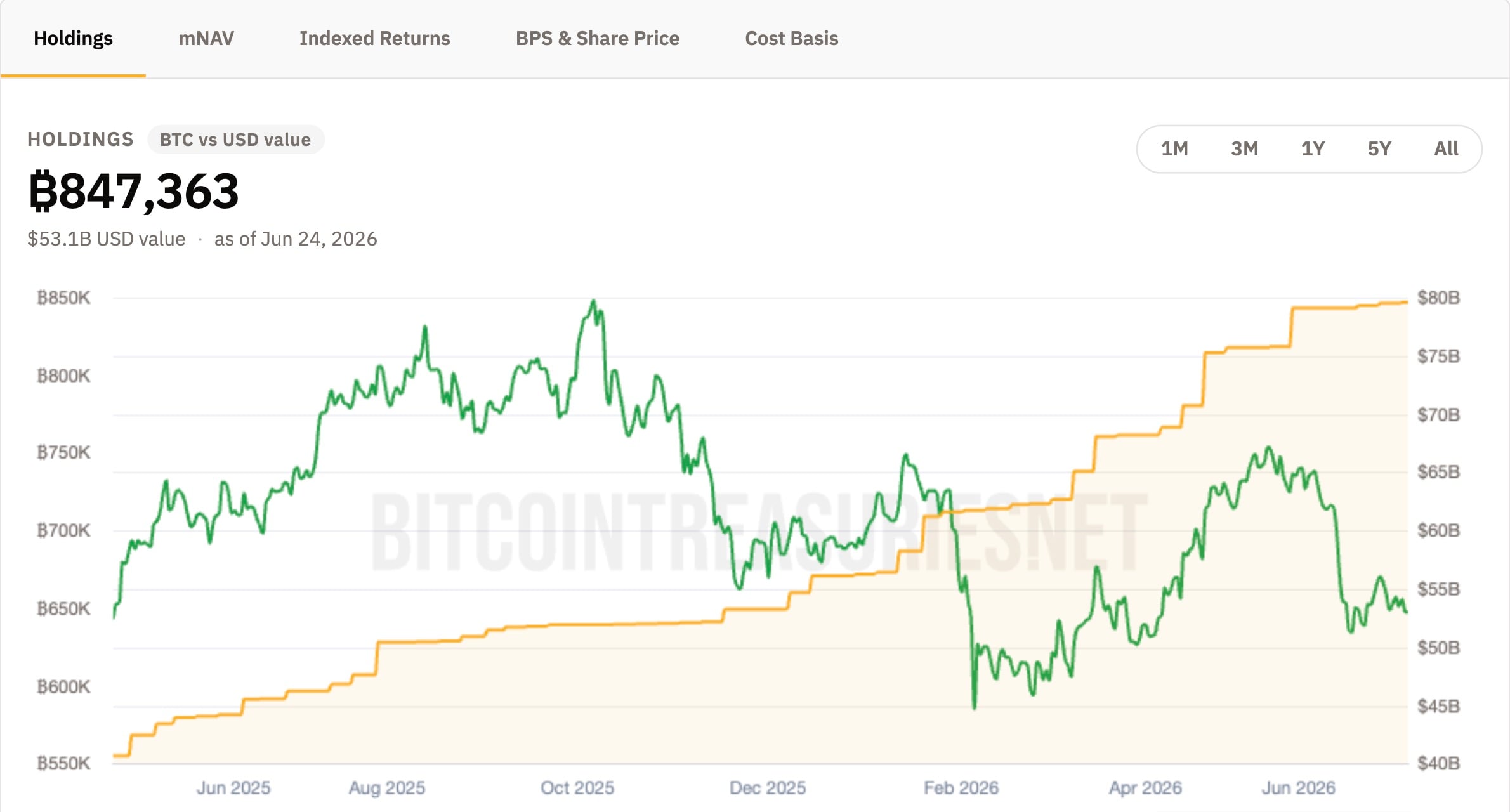
Investor sentiment is reflected in the debt market, where the giant's capitalization fell to $37.5 billion, while its shares began trading at a deep discount to the net value of its Bitcoin holdings.
The situation is worsened by the fact that the total volume of obligations tied to digital tokens has reached $12.19 billion, while their yield on the secondary market has jumped to a critical 11–15%. This is a clear signal that major players are seriously concerned about a default.
3-step plan to save Strategy by Edwards
To keep the crypto giant afloat, Edwards published a radical three-step anti-crisis plan that proposes fully restructuring its framework, starting with a total debt cleanup. Under this plan, Saylor would have to repay all $12.19 billion in obligations, shut down products with artificial yield, and return to the safe holding of a clean Bitcoin stack.
Second, instead of buying expensive coins on the open market, the company should switch to aggressive acquisitions of digital asset treasury structures, or DATs, which are now trading at discounts of 50% or more to their net asset value. This would allow Strategy to obtain Bitcoin at a deep discount and consolidate the market, reducing the number of players from two hundred to fewer than ten.
The final stage would be the transformation of the giant into a full-fledged Bitcoin bank that issues loans and conducts settlements in BTC, generating profit exclusively against real, strictly liquidated collateral from counterparties.

As proof that an alternative M&A strategy works, Edwards points to a recent European precedent involving Sweden's H100 Group, which received shareholder approval to acquire two Norwegian companies and increased its balance sheet to 3,500 BTC. Most importantly, this merger took place without any fiat loans or bond issuance, as payment was made entirely through the issuance of shares.
This completely eliminated any margin-call risks in the event of a decline in the cryptocurrency market.
"Sooner or later, the music will stop," Edwards concluded, reminding Saylor that without a painful debt restructuring, his debt burden could inevitably burst like a bubble.
 U.Today Editorial Team
 Dan Burgin
