
Disclaimer: The opinions expressed by our writers are their own and do not represent the views of U.Today. The financial and market information provided on U.Today is intended for informational purposes only. U.Today is not liable for any financial losses incurred while trading cryptocurrencies. Conduct your own research by contacting financial experts before making any investment decisions. We believe that all content is accurate as of the date of publication, but certain offers mentioned may no longer be available.

As decentralized finance continues to evolve, the limitations of current on-chain trading infrastructure have become increasingly apparent. From liquidity fragmentation and slow execution to persistent MEV risks and complex user experiences, both retail and institutional participants are still facing significant barriers. Against this backdrop, builders who have experienced these challenges firsthand are now working toward more scalable and efficient solutions.
Sameep Singhania is one of those builders. Having entered the blockchain space in 2017 and contributed early to DeFi infrastructure through projects like QuickSwap, he has seen the ecosystem mature from its earliest stages. His latest venture, KalqiX, aims to address some of DeFi’s most persistent inefficiencies by combining high-performance trading architecture with privacy-preserving technology.
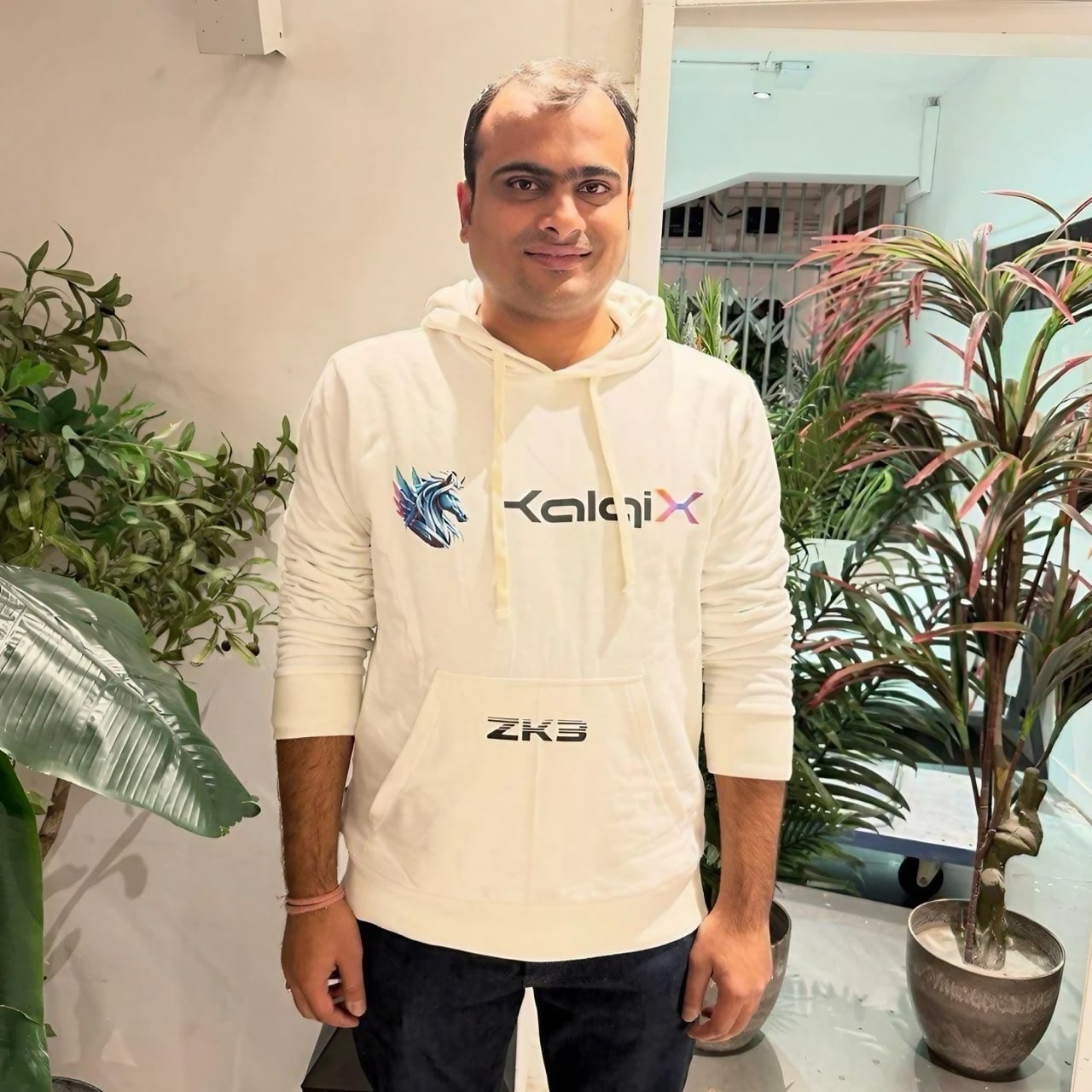
In this interview, Sameep shares insights from his journey in Web3, the lessons learned from building large-scale DeFi platforms, and how KalqiX is working to bring centralized exchange-level performance on-chain without compromising trustlessness.
U.Today: Sameep, you’ve been building in Web3 since 2017 and were an early contributor to DeFi infrastructure. What originally drew you into blockchain, and what made you stay?
Sameep Singhania: Back in 2017, after leaving my 9-to-6 job, I started freelancing, and that’s when I landed my first blockchain project. What really caught my attention was the idea of trustless systems. The fact that you could build something where users don’t have to rely on intermediaries was very powerful.
But what made me stay was the realization that this isn’t just a new technology, it’s a completely new way of building financial systems. Over time, I saw how early everything was, and that motivated me even more. There was so much to fix, so much to improve, and that’s what kept me here.
U.T.: What key lessons from building QuickSwap are shaping your approach to KalqiX today?
S.S.: One of the biggest lessons I learned was the importance of building long-term partnerships and integrations. QuickSwap has close to 5,000 integrations, and that network effect is what made it so resilient and powerful on Polygon.
Another major lesson was that user experience matters more than pure technological innovation. No matter how advanced the technology is, adoption ultimately depends on how easy and intuitive the product is for users and their community.
With QuickSwap, we saw massive growth, but we also saw where things break – UX issues, liquidity fragmentation, inefficiencies of AMMs.
U.T.: What made you start building KalqiX?
S.S.: It came from a very clear gap. On-chain trading, as it stands today, forces severe trade-offs.
You can have speed, or privacy, or trustlessness… but never all three.
Every public trade leaks strategy. MEV bots quietly tax users. And if you want real performance, you’re pushed back onto centralized exchanges, giving up custody of your assets alongside trust that trades will be executed fairly.
So the idea behind KalqiX was simple: why can’t we bring CEX-level performance on-chain without compromising trustlessness? That’s the problem we’ve solved.
U.T.: What would you say are the biggest challenges users still face on DEXs today?
S.S.: A few very obvious ones: slow execution, slippage, poor liquidity depth, MEV exploitation, overall confusing UX, and liquidity fragmentation. For normal users and institutions, this creates too much friction. That’s why most volume still sits on centralized exchanges. Until these problems are solved properly, DeFi won’t go mainstream.
U.T.: KalqiX introduces a central limit order book combined with zero-knowledge proofs. What does that actually mean in practice for traders?
S.S.: In simple terms, traders get the experience of a centralized exchange but without giving up custody. CLOB enables better price discovery, tighter spreads, and more control over orders, while zero-knowledge proofs ensure that everything is verifiable, with no hidden manipulation and no need to trust the system. So, from a trader’s perspective, it ultimately delivers speed, transparency, and privacy under a single umbrella.
U.T.: You’ve worked closely with the Polygon ecosystem and Layer 2 scaling. How do you see the role of L2s evolving in the next phase of DeFi growth?
S.S.: L2s have already solved a big part of the scalability problem. The next phase is about specialization. Different L2s will optimize for different use cases, such as trading, gaming, and payments.
For trading specifically, performance is everything. So, we’ll see more systems built specifically for high-speed execution, not just general-purpose scaling. And to reiterate it again, L2s don’t always mean EVM-based appchains. Any application that scales a certain category and does final settlement on-chain (L1) is an L2.
U.T.: MEV remains a major issue in DeFi. How does KalqiX specifically address front-running and other forms of exploitation?
S.S.: MEV exists because of how public mempools and transaction ordering work. At KalqiX, we reduce that attack surface significantly.
At its core, KalqiX separates execution from visibility. Sensitive trading data – intent, size, strategy – is handled within a zero-knowledge layer, removing the information asymmetry that MEV bots rely on.
The system still proves that trades are valid and fairly executed without exposing the underlying data. This allows us to eliminate MEV while delivering high-performance, trustless, on-chain trading.
U.T.: What needs to be set as a goal for DeFi developers at the current moment?
S.S.: Stop building for crypto-native users only. Build for the evolution of Web3 and not for the demise of Web2. We all need to understand that Web3 is just an evolution of Web2. The goal should be to build products that anyone can use – without needing to understand wallets, gas, or blockchain mechanics. If we want real adoption, we need to focus on simplicity, performance and reliability. Everything else comes later.
U.T.: Institutional players are showing increasing interest in DeFi. What needs to change for them to fully embrace on-chain trading infrastructure?
S.S.: Every serious institution will eventually move toward privacy, fairness, performance, and reliability. Right now, DeFi is still not consistent enough for large-scale institutional participation.
Once execution quality matches traditional systems and there’s better infrastructure around compliance and reporting, institutions will naturally come in. That’s what we are building at KalqiX.
U.T.: You’re building a white-label exchange model where others can launch their own branded platforms. What inspired this approach?
S.S.: My experience at QuickSwap played a big role in shaping this approach. What we saw there was that, over time, it became extremely difficult for anyone to compete with QuickSwap on Polygon, not just because of the product but because of the thousands of integrations and partnerships built behind the scenes.
That’s when the realization clicked. Instead of competing for users as a single exchange, why not empower many? There are already strong communities, brands, and platforms with users, but they don’t have the infrastructure to run a high-performance exchange.
KalqiX changes that. They can plug into our system and launch instantly, with their own brand and user base. It’s simply a much faster and more scalable way to grow the entire ecosystem.
U.T.: Do you see KalqiX more as a product or a broader ecosystem for exchanges?
S.S.: Definitely an ecosystem. The exchange is just one part. The bigger vision is to become the underlying execution layer for multiple exchanges, all compounding liquidity, volume, and value back to the same network. That’s where the real value is.
U.T.: When do you plan to launch perpetuals and advanced products on KalqiX?
S.S.: Perpetuals and derivatives are definitely on the roadmap. But we’re very focused on getting the core right first – spot trading, execution, liquidity. Once the foundation is strong, expanding into advanced products becomes much easier and much more meaningful. Long term, KalqiX is not just an exchange, it’s a full financial ecosystem.
U.T.: Is there anything else you’d like to share or add before we close this out?
S.S.: We’re still very early. A lot of people think DeFi has already peaked, but in reality, we haven’t even solved the core problems yet. KalqiX is our attempt to fix those fundamentals. If KalqiX and similar systems succeed, DeFi in 10 years will look very different from today.
 U.Today Editorial Team
 Dan Burgin
 Vladislav Sopov
