

Disclaimer: The opinions expressed by our writers are their own and do not represent the views of U.Today. The financial and market information provided on U.Today is intended for informational purposes only. U.Today is not liable for any financial losses incurred while trading cryptocurrencies. Conduct your own research by contacting financial experts before making any investment decisions. We believe that all content is accurate as of the date of publication, but certain offers mentioned may no longer be available.

The market is on something similar to a pause as we see a lack of consolidation and growth potential for assets like Ethereum, XRP and SHIB. However, it might change sooner than expected. Lower volatility on the weekend is certainly not something the majority of investors should be worried about.
Ethereum's weird pacing
Ethereum appears to have weathered its decline and is getting ready for a more significant comeback. ETH is now stabilizing above the $3,000 mark and constructing structure rather than bleeding out after months of declining and frequently failing at significant moving averages. That alone indicates a distinct change in behavior.
Where the price is staying is the most significant shift. Ethereum is circling its short-term exponential moving averages, especially the 26 EMA, which has begun to function as dynamic support as opposed to resistance. In earlier attempts, ETH would touch this zone for a short while before rolling over nearly instantly.
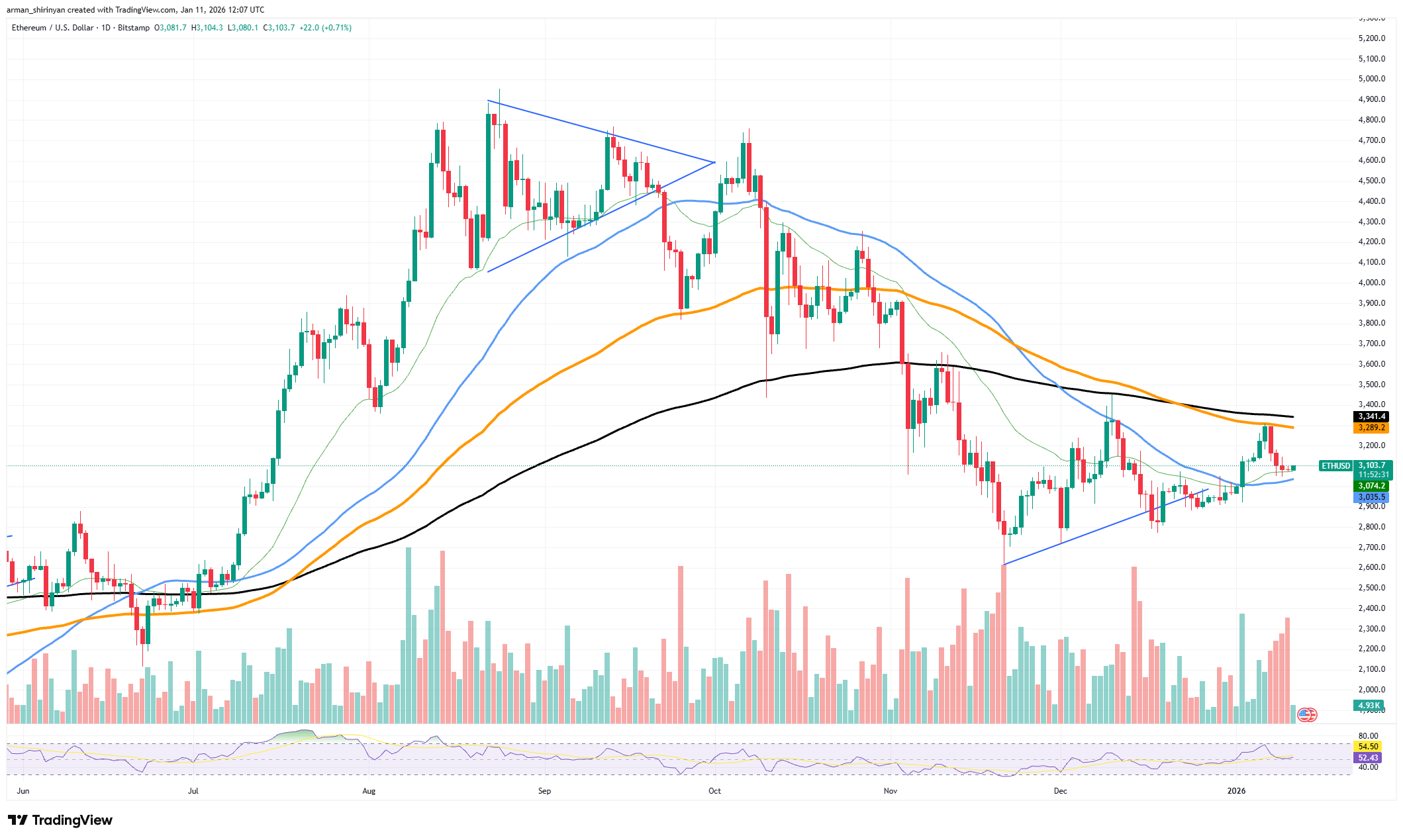
It appears that buyers are no longer viewing rallies as chances to sell because the price is consolidating on top of it this time. Moreover, momentum is increasing. The recent push higher was a consistent advance with higher lows forming on the daily chart rather than a single vertical candle followed by distribution.
The volume has increased to the point where the move is valid without indicating exhaustion. A sustainable recovery as opposed to a blow-off bounce looks precisely like that. From a technical standpoint, it would be premature to declare this a complete trend reversal because Ethereum is still below the 100 and 200-day moving averages.
The difference between those levels and price however is getting smaller. The likelihood of a more significant trend shift rises dramatically if ETH can maintain its respect for the 26 EMA while moving closer to the 50 EMA. The market will have to determine whether this is merely a relief rally or the beginning of something more sustainable in that area.
This time, the context is different. The market is no longer pricing in panic or under duress. Rather, ETH is rising as volatility contracts, which typically comes before an increase. This does not imply straight-line gains, but it does indicate that buying dips is more likely.
XRP's short-term fuel
A technical signal that traders often overlook until it is priced in is being subtly flashed by XRP. In the current context, the recent interaction between the 26 and 50 exponential moving averages is forming what appears to be a short-term golden cross, which is more significant than usual. XRP has been steadily declining on the daily chart for months within a distinct descending structure.
The downward trend has now been broken to the upside, and instead of a sharp rejection there has been a controlled pullback. The EMA structure becomes important in this situation. A change in short-term momentum is indicated by the 26 EMA crossing above the 50 EMA.

Although it frequently indicates a change from distribution to accumulation, this type of cross does not ensure a trend reversal. The location of this setup is what makes it intriguing. After XRP printed a higher low and reclaimed short-term support in the $2.00 area, a cross is beginning to form.
In the past when the price spiked into moving averages, it was immediately hit hard. This time, instead of simply pausing, sellers appear to be losing control as XRP is consolidating above them. Volume behavior lends credence to that theory. The pullback is not accompanied by strong sell pressure, which suggests that recent buyers are not hurrying to get out.
Additionally, RSI is maintaining its neutral range, allowing for growth without becoming overheated. Usually, that combination encourages continuation rather than collapse. The 50 EMA is now the crucial line to keep an eye on. The likelihood of a push toward the next resistance zone rises dramatically if XRP is able to stay above it and begin using it as support.
The higher time frame moving averages, which would be the true litmus test for any more comprehensive recovery story, are closer to that zone. A parabolic move is not called for here. Macro conditions are important, and XRP still has overhead structural resistance. However, a real short-term growth signal that frequently comes before trend normalization is the 26/50 EMA cross.
Shiba Inu's volumes are gone
Shiba Inu is in one of those awkward dead zones that long-term holders frequently misinterpret and traders detest. It is not an exaggeration to say that volume has fallen to almost nothing. Following the recent surge, activity on the daily chart has virtually stopped, leaving the price to drift with little conviction on either side.
SHIB is not doing much in terms of price action. Following a strong relief move, the asset is currently hovering just above short-term support, but follow-through buying has not materialized. That is the main problem. This kind of disappearance of volume makes price movements meaningless.

Candles can be moved by small orders but none of this is indicative of true demand. This is an accumulation driven by inertia rather than confidence. Generally speaking, low volume indicates weakness rather than strength. It shows weariness in the case of SHIB. Since the overall setup has not improved, buyers are not intervening forcefully because sellers have already done their damage earlier in the downtrend.
Because exchange reserves are still high, supply pressure is always present. Even if the price attempts to rise, there is no way to absorb that supply without volume. However, a near-zero volume does not always indicate that another crash is about to occur. It usually signifies a phase of transition.
This type of flat lifeless trading frequently precedes volatility, and markets typically compress before expanding. What happens next will determine the direction of that volatility. A short-term squeeze could be caused by a sudden spike in volume combined with the recovery of important moving averages. However, the downside opens up quickly if volume on the sell side increases again.
SHIB is essentially on hold for the time being. The idea that the market is waiting rather than positioning is reinforced by indicators like RSI, which are currently in neutral territory. Everyone is not in a rush. That is not panic, but it is also not bullish. Here, investors should be realistic.
A trend is impossible without volume. Participation is necessary for SHIB to support any story that goes beyond sideways drift. Price action will continue to be brittle, susceptible to change and essentially meaningless until activity returns in a significant manner.
 U.Today Editorial Team
 Dan Burgin
