

Disclaimer: The opinions expressed by our writers are their own and do not represent the views of U.Today. The financial and market information provided on U.Today is intended for informational purposes only. U.Today is not liable for any financial losses incurred while trading cryptocurrencies. Conduct your own research by contacting financial experts before making any investment decisions. We believe that all content is accurate as of the date of publication, but certain offers mentioned may no longer be available.

The market is not seeing inflows that will help it get through the weekend without losses. Unfortunately, though, there is a pretty high chance of a discontinuation of the bull market by the beginning of the year.
Will Bitcoin keep $90,000?
Once more, Bitcoin is perilously close to the psychologically charged $90,000 mark. The next 48 hours are more important than they may appear after a severe rejection from higher levels and a wider market cooling. The weekends tend to reveal weak structures, and while Bitcoin's current configuration is precarious, it is not hopeless.
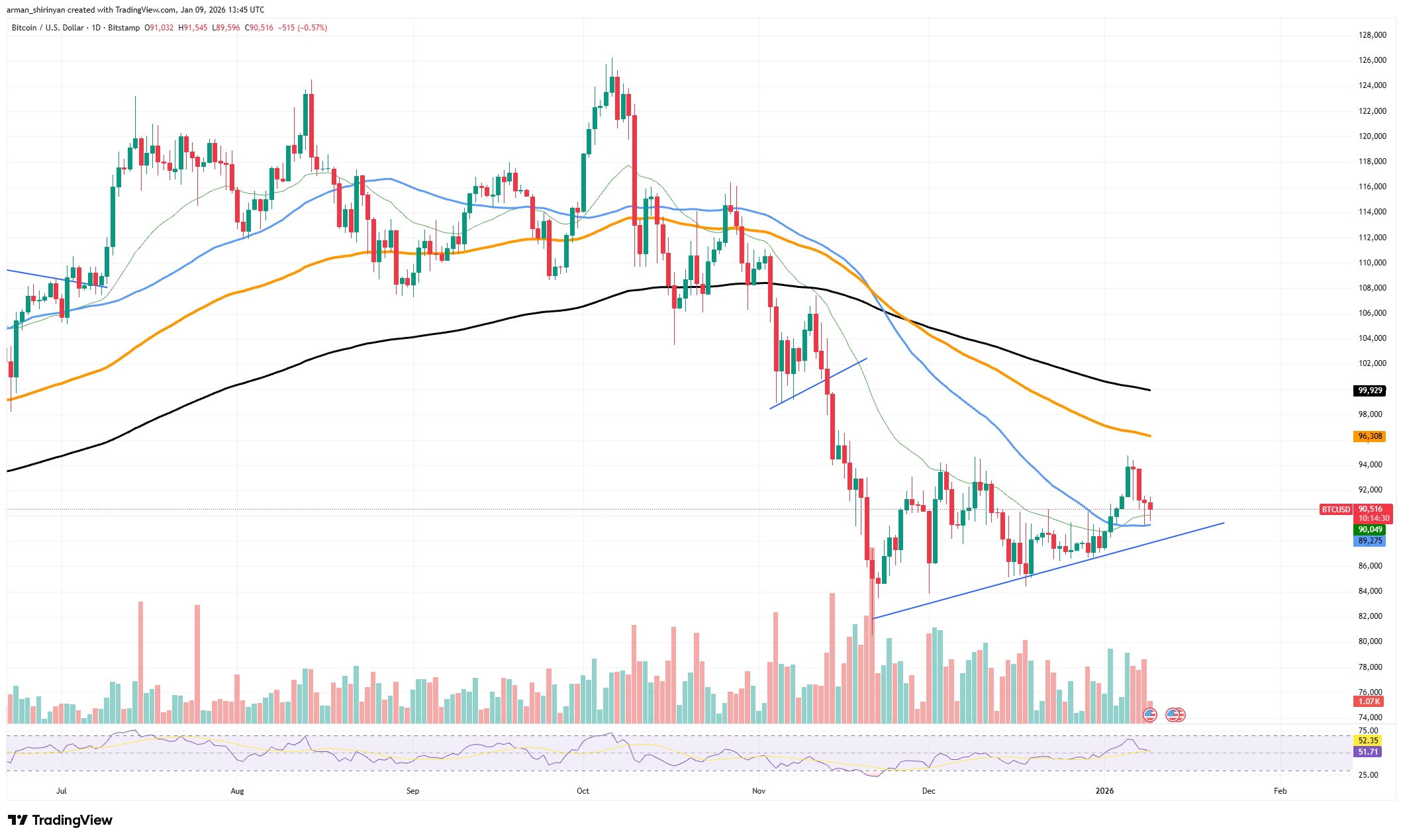
Technically speaking, $90,000 is short-term structural support rather than merely a round figure. The price has already cooled off momentum indicators, flushed lower and shaken out late longs. Compared to the violent sell-off phase, volatility has decreased, and the RSI is no longer screaming overheated. At that point, stabilization usually occurs or another leg opens rapidly. The main factor favoring Bitcoin at the moment is that selling pressure has decreased following the initial dump.

The price is trying to establish a base above the rising local trendline, and there is no obvious acceleration to the downside. It would be a victory on its own if Bitcoin could remain above $90,000 during a weekend with low liquidity. It would indicate that sellers are becoming less urgent, and that the market might be shifting from panic to consolidation. However, nothing is assured here.
There is not much significant support below that level until the mid-to-high $80,000s, and a weekend breakdown could amplify the move because order books are thinner. Another round of stop losses could be triggered by a single rash sell wave.
The most plausible short-term scenario is dull but beneficial: Bitcoin holds $90,000, chops sideways and stays out of a deeper decline. Moving averages would be able to catch up as a result, paving the way to a more restrained recovery the following week. This market requires time, so investors should not anticipate an instantaneous V-shaped bounce.
XRP's premature reaction
The patience of traders is being tested once again by XRP, but it would be premature to write it off at this point. The asset continues to exhibit indications of structural relevance rather than complete collapse despite months of corrective price action and repeated failures to reclaim higher resistance zones.
The current configuration is not terminal, but it is weak. In terms of price, XRP is still under pressure since it was unable to maintain its position above important moving averages. Sellers are still active on rallies, as evidenced by the recent rejection close to the 100 and 200 EMA zone. But the price is no longer falling as quickly as it did at the beginning of the correction, and the decline has significantly slowed.

Change is important. Rarely do markets reverse from strength; instead, they reverse due to weariness. The characteristics of XRP's comebacks are what investors should be focusing on right now. With the help of decreasing selling volume, XRP has been able to create higher lows locally even during a larger downtrend.
This implies that even though upside momentum is still capped, distribution is not getting more intense. To put it another way, there are sellers, but they are not forceful enough to initiate a breakdown on their own. This opinion is supported by the RSI hovering around neutral territory. XRP is neither extremely oversold nor overbought, which usually precedes consolidation, as opposed to sharp continuation in either direction.
Both bulls and bears are frequently frustrated by this type of compression, but it also creates the framework for a later, more forceful, move. Investors should not anticipate an abrupt bullish reversal or an instant recovery. In order to do so, XRP would need to recover and maintain above the 50 and 100 EMA levels with volume confirmation that has not yet occurred. Rallies will probably encounter opposition until then.
Ethereum set for $3,000
Contrary to what recent price action may indicate, Ethereum is subtly setting itself up for a possible return above the $3,000 level. The current structure indicates early indications of stabilization rather than a continuation of the previous sell-off, even though ETH is still trading below significant resistance zones.
The relationship between Ethereum and the 26-day exponential moving average is among the most significant developments. ETH has recovered and is currently hovering around this level following weeks of trading below short- and midterm trend indicators. Ethereum has traditionally used the 26 EMA as a momentum pivot to distinguish between trend reversals and corrective phases.

While holding above it does not ensure a rally, it does establish a technical base from which buyers can start to take back control. This interpretation is supported by the price behavior during the previous sessions. Rebounds are no longer sold into right away, downside extensions are becoming shorter and selling pressure has subsided.
This change implies that supply is being absorbed by the market more effectively. Additionally, volume has returned to normal, suggesting that panic-driven exits are probably behind the market for the time being. From a wider angle, Ethereum is still constrained by stronger resistance around the $3,300-$3,400 range and the 50 EMA. To verify a persistent trend reversal, a clear break above those levels would be necessary.
However, straight lines are rarely seen in market movements. Expansion is frequently preceded by consolidation around the 26 EMA, particularly when momentum indicators like the RSI stay neutral rather than overheated. Crucially, Ethereum can rise without an abrupt surge in speculative demand.
Reduced selling and consistent accumulation would be sufficient to propel ETH back toward $3,000. That level is as much psychological as technical, and a successful recovery could greatly boost market sentiment. However, risks still exist.
Any recovery narrative would be delayed if Ethereum failed to hold the 26 EMA, which would probably expose it to another retest of lower support levels. However, a $3,000+ move is no longer a stretch given the current structure. If Ethereum keeps gaining support where it counts most, this is a conceivable result.
 U.Today Editorial Team
 Dan Burgin
