


Cryptocurrency regulation in the United States is entering a more structured phase, as lawmakers move to resolve key gaps in legislation and shift away from years of fragmented oversight driven by enforcement actions.
A new development reported by Punchbowl News shows Senate negotiators have reached an agreement on stablecoin yield language within the proposed CLARITY Act, addressing one of the most contentious issues holding back progress.
What is CLARITY Act?
The proposed CLARITY Act, already approved by the House, aims to resolve one of the industry’s biggest challenges: determining whether a digital asset is a security or a commodity.
Under this framework, decentralized tokens with no central control would fall under the jurisdiction of the Commodity Futures Trading Commission, while assets tied to investment expectations or centralized development would remain under the Securities and Exchange Commission.

This distinction is intended to eliminate regulatory overlap and provide businesses with clearer compliance pathways.
Stablecoin yield debate nears resolution
The compromise, led by Senators Thom Tillis and Angela Alsobrooks, introduces restrictions on rewards tied to stablecoins.
Under the new language:
- Rewards that function like interest on bank deposits are prohibited
- Incentives tied to legitimate platform activity remain allowed
- Regulators will define disclosure standards and approved reward structures
This clarification directly builds on the GENIUS Act, which banned interest payments by issuers but left ambiguity around secondary market practices.
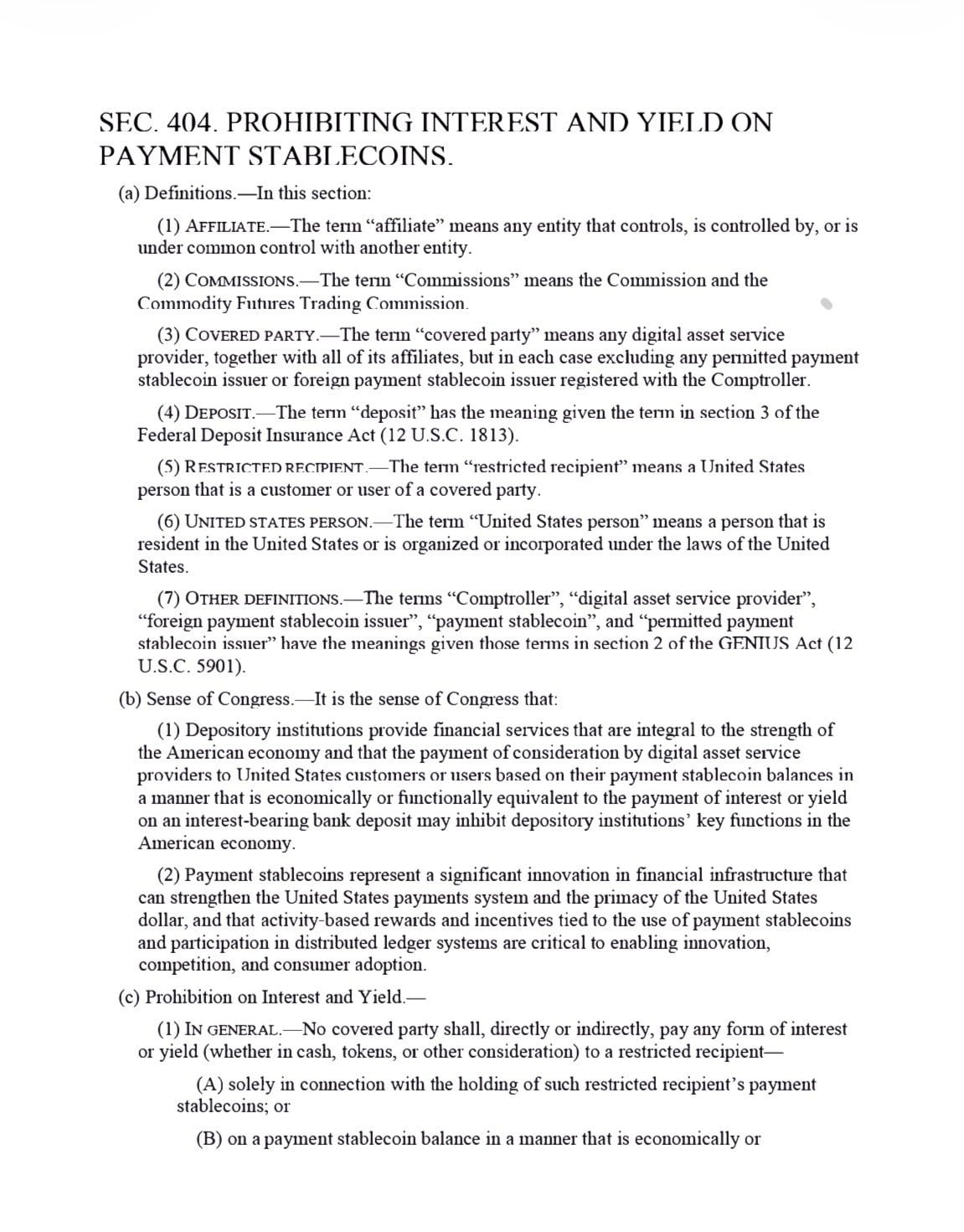
The agreement removes a major obstacle that had delayed broader legislative progress. Senate Banking Committee Chairman Tim Scott is now targeting a potential markup of the CLARITY Act in May.
If advanced, the bill would:
- Define whether digital assets are securities or commodities
- Clarify oversight roles between the SEC and CFTC
- Establish clearer compliance pathways for crypto firms
Industry groups have long argued that these definitions are essential to replace “regulation by enforcement” with predictable legal standards.

The latest development reflects a broader shift in U.S. policy. With the GENIUS Act already in force and the CLARITY Act progressing, lawmakers are building a coordinated framework that addresses stablecoins, market structure, and investor protections.
At the same time, debates continue around other elements of crypto policy, including decentralized finance safeguards and restrictions on a potential central bank digital currency.
What it means
The stablecoin yield compromise signals growing alignment between policymakers and industry concerns. By closing one of the most debated loopholes in existing legislation, it brings the U.S. closer to a comprehensive regulatory system.
While key provisions are still under negotiation, the direction is increasingly clear: digital assets are being integrated into formal financial regulation, with defined rules replacing uncertainty.
Overall, the United States is moving toward a coordinated regulatory system that defines responsibilities across federal agencies while maintaining space for innovation.
The general duration is from a system where rules were inferred through lawsuits to one where they are explicitly written into law.
 Dan Burgin
 U.Today Editorial Team
