
Disclaimer: The opinions expressed by our writers are their own and do not represent the views of U.Today. The financial and market information provided on U.Today is intended for informational purposes only. U.Today is not liable for any financial losses incurred while trading cryptocurrencies. Conduct your own research by contacting financial experts before making any investment decisions. We believe that all content is accurate as of the date of publication, but certain offers mentioned may no longer be available.

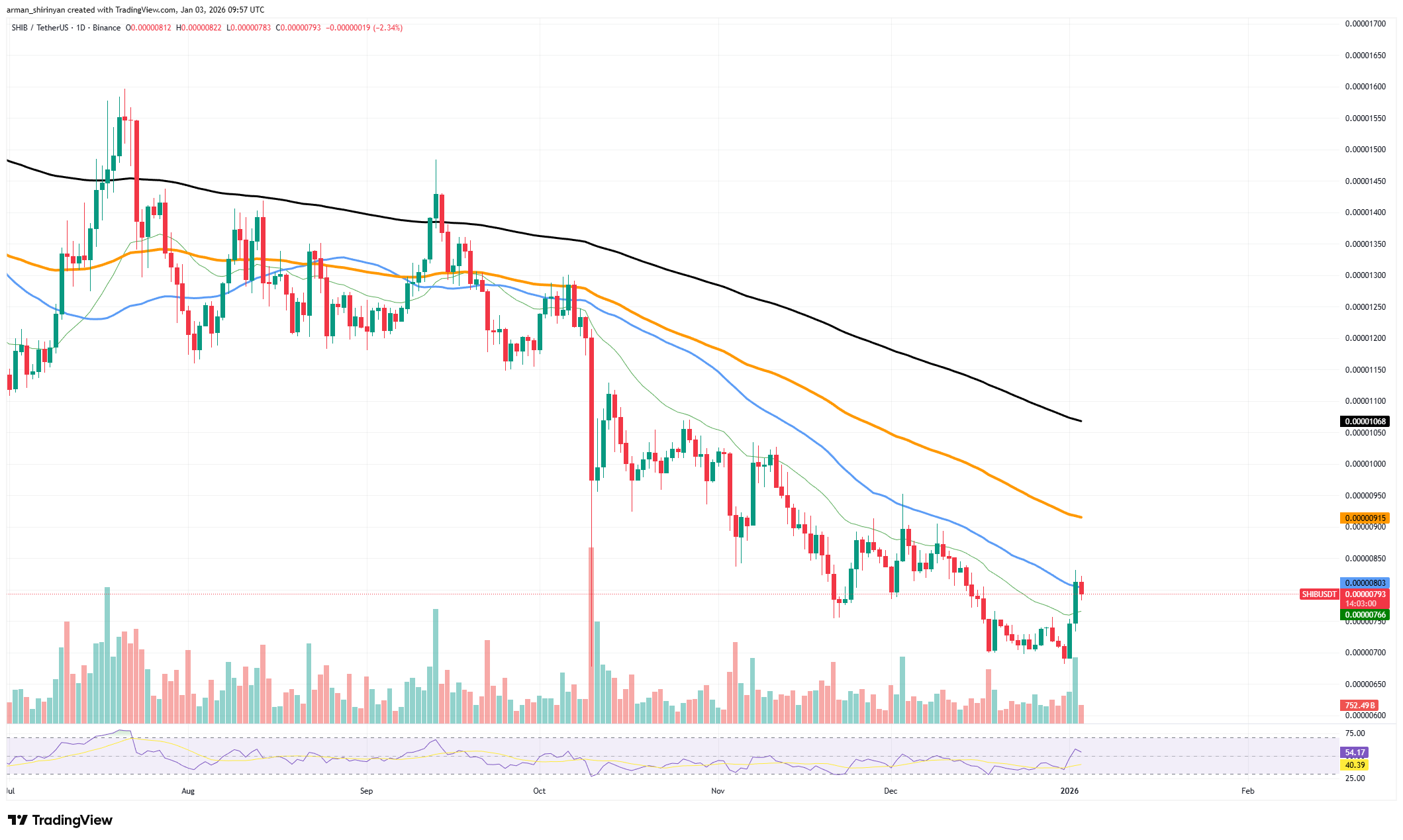
The Shiba Inu market is not behaving like it is going to blow up. It is behaving as if it has been depleted, compressed and left to determine whether it is capable of rising again. That reality is reflected in price action: SHIB is still trapped in a wider downtrend, trading below its major moving averages with rallies being sold into rather than sustained.
Shiba Inu's market damage
Damage control is a more accurate term for the current state of affairs on the Shiba Inu network. The 426 billion SHIB netflow is the headline figure that has people talking. That seems like a huge amount on paper. In actuality, context is necessary. The difference between tokens entering and leaving exchanges is all that netflow measures. A high number does not always indicate buy pressure or bullish accumulation. It simply denotes motion.
Exchange reserves continue to rise at this time. It is more important than the netflow figure. Token positioning for liquidity rather than long-term storage is typically indicated by rising reserves. To put it simply, there is no tightening of supply. The notion that the 426 billion SHIB outflow is some sort of covert bullish catalyst is undermined by that alone.
Sell-side volume
Not completely, but could it all be sell-side? Wallet migrations, internal reorganization and short-term positioning probably make up a portion of that flow. However, markets value results rather than intentions. Thus far, the results are straightforward: volume spikes are erratic, SHIB is unable to recover broken levels, and every bounce almost instantly runs into overhead supply.

Technically speaking, SHIB's recent surge appears to be more of a relief move than a reversal. Although the RSI has risen from low levels, it has not entered any zone that has historically indicated a long-term trend shift. The fact that the asset is still trading below its long- and medium-term averages indicates that sellers are still in structural control.
Perhaps indirectly, but can 426 billion SHIB influence the price? The situation would be different if that flow were combined with diminishing exchange reserves, tightening liquidity and evident demand absorption. That has not happened yet. This is not a front-run pump arrangement for investors.
 Dan Burgin
 U.Today Editorial Team
