


As the prolonged crypto market volatility continues to persist for several months, Bitcoin’s on-chain activity has also cooled massively over the period.
Recent data shared by crypto analytics platform Cryptoquant shows that the number of active addresses on Bitcoin has dropped by over 30% from the peak levels it achieved in 2025.
While the active address metric is significant in measuring the network participation of the concerned asset, it basically tracks the number of unique wallet addresses sending or receiving Bitcoin within a given period.
It typically indicates Bitcoin network usage, allowing analysts to easily predict whether the asset is gaining momentum or not.
Bitcoin active addresses drop to 655,908
The data further revealed that Bitcoin recorded 938,609 active addresses on Aug. 8, 2025.
While the market has turned extremely negative since the last quarter of 2025 until this time, that number had fallen to 655,908 by March 25, 2026.
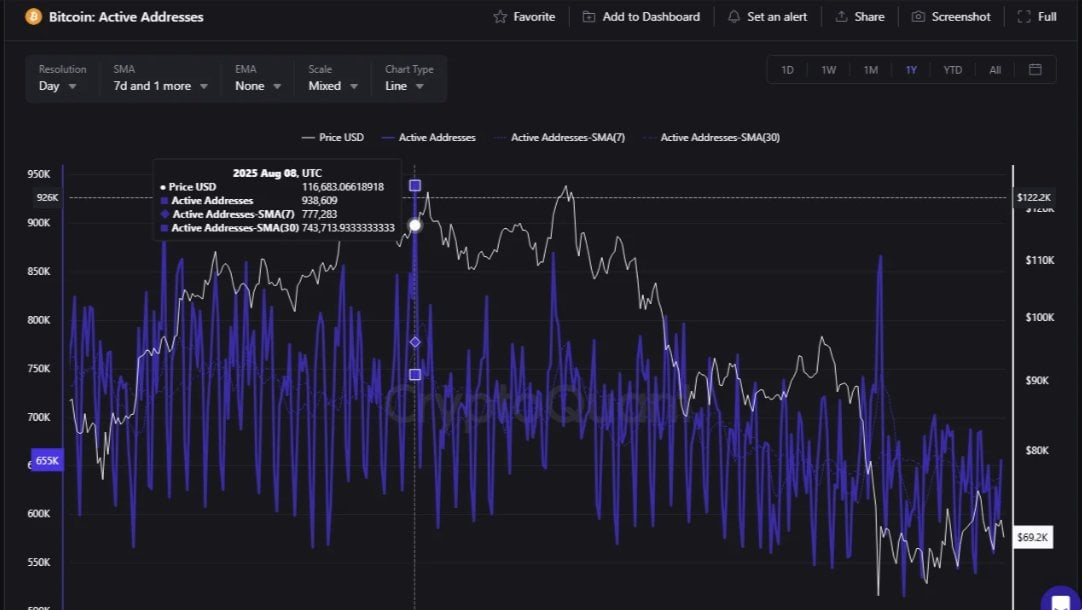
In addition to this, the Cryptoquant analyst further revealed charts showing that the seven-day moving average of active addresses has dropped from 777,283 to 612,972.
While this marks a 21.14% decrease in the weekly metric, the 30-day moving average has also declined from 743,714 to 636,314, representing a 14.44% drop.

While the declines have persisted for several months, the drop in Bitcoin’s network activity is unlikely to be attributable to short-term volatility, but rather, a sustained cooling of user participation.
Bitcoin price weakens
Over the period, Bitcoin has also traded consistently in the red zone, dropping to significant lows in price as investors increasingly withdraw participations.
While Bitcoin’s price action has become extremely weak over time, with network performance also falling substantially, the Bitcoin ecosystem appears to be facing lower capital rotation, fewer transactions and weaker organic demand across the network.
As such, analysts predict that a resurgence in the asset’s network participation could further drive a strong rebound in its price.
 U.Today Editorial Team
 Dan Burgin
