
Disclaimer: The opinions expressed by our writers are their own and do not represent the views of U.Today. The financial and market information provided on U.Today is intended for informational purposes only. U.Today is not liable for any financial losses incurred while trading cryptocurrencies. Conduct your own research by contacting financial experts before making any investment decisions. We believe that all content is accurate as of the date of publication, but certain offers mentioned may no longer be available.

TL;DR
- XRP's Binance Scarcity Index jumped to 0.77 in early July, the highest reading since summer 2024, as whales pull coins into non-custodial wallets while price holds near $1.14.
- A BitGo-custodied wallet moved 114.9 billion SHIB, worth about $502,230, into a previously inactive cold wallet, a signal of accumulation rather than sell pressure.
- Strategy CEO Phong Le published a manifesto calling Bitcoin a "guarantor of monetary freedom," even as the company sold 3,588 BTC for $216 million across two tranches.
- Bitcoin fell below $62,000 as the miner stress index hit 0.00, matching capitulation lows from 2015, 2018, 2020, and 2022.
- Markets are watching the July 7 NY Fed inflation expectations and July 8 FOMC minutes as the next directional catalyst.
Binance records XRP's deepest scarcity since 2024
XRP entered the third quarter of 2026 with a sharp imbalance in its supply structure. According to fresh on-chain data from CryptoQuant, published this Monday, Binance has recorded a historic draining of XRP order-book liquidity.
The specialized Binance XRP Scarcity Index made a vertical jump to 0.77 in the first days of July — the highest level of liquidity shortage since the summer of 2024.
Analysts at Arab Chain stress that the worsening scarcity is isolated in nature. While XRP's spot price is trading near $1.14, attempting to hold above local resistance after a push to $1.159, the freely circulating supply of coins is shrinking quickly.
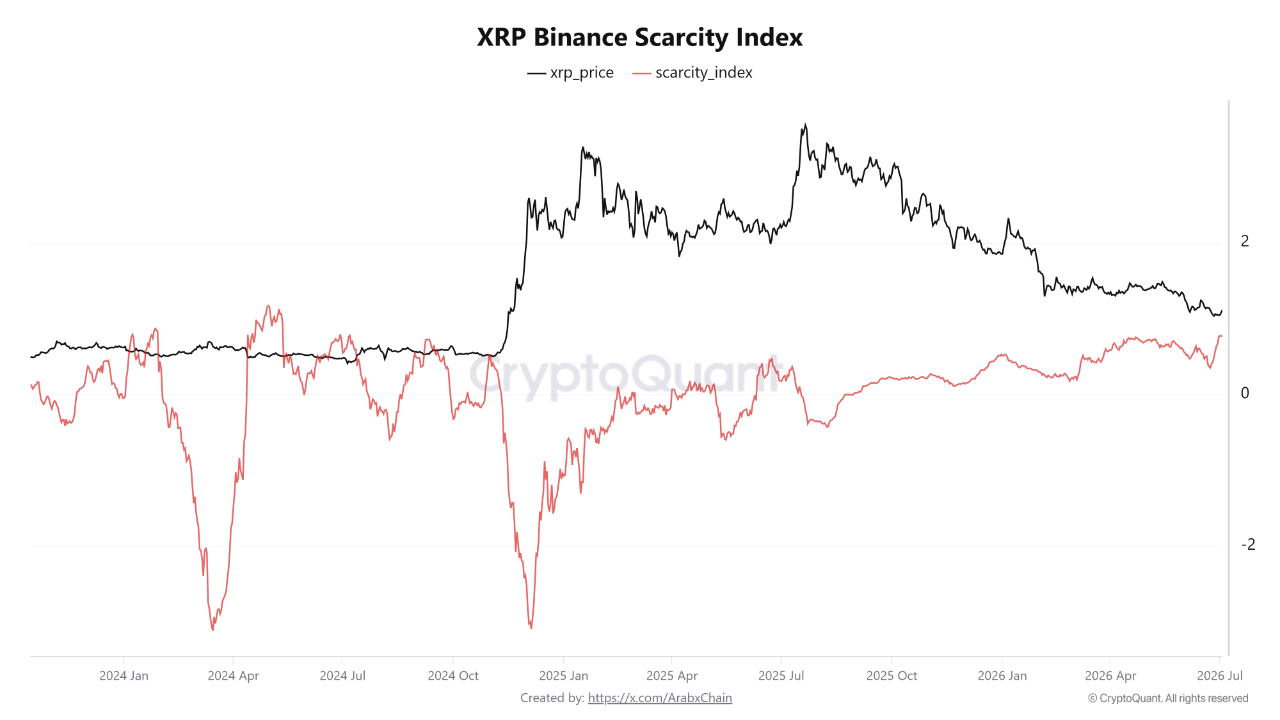
The trend shift is being driven by large holders: around the turn of the half-year, whales minimized new deposits and intensified withdrawals to non-custodial wallets, effectively removing tokens from the market.
Historically, this kind of reserve drain at the start of July has acted as a strong leading indicator. Selling pressure declines, while the situation in the order books tightens like a spring, and since July traditionally opens a period of higher activity for XRP, any local inflow of buyer demand — against the backdrop of continued inflows into XRP ETFs — could trigger a sharp price impulse.
The nearest target for the start of a rally is the $1.17–$1.20 zone, while in the case of market cooling, the asset could return to firm support at $1.10.
BitGo whale hides 114 billion Shiba Inu coins in a new wallet
While the crypto market opens July 2026 in prolonged consolidation, major players have begun hidden maneuvers. A whale used the BitGo custody service and withdrew 114.9 billion SHIB through the WalletSimple platform in two transactions, according to Arkham.
This entire massive token volume settled at a completely new address that had previously been inactive. At the current rate on July 6, 2026, which is holding near $0.0000044 per token, the wallet balance is valued at approximately $502,230.

According to on-chain tracker data, SHIB tokens were transferred directly to a cold address, bypassing the hot wallets of centralized trading platforms.
This route means there is no immediate pressure on the meme coin's market order book. For the current market phase, this is a classic marker of preparation for a large over-the-counter deal or a transfer of assets into long-term storage by a major fund.
Further activity from this wallet is worth watching especially closely for Shiba Inu token holders.
Strategy manifests freedom while the market counts its million-dollar sales
At the start of the new week, Strategy CEO Phong Le published the "Bitcoin is Freedom" manifesto, calling the first cryptocurrency "the United States of money." The executive drew a parallel between the blockchain's algorithmic code and the U.S. Constitution, arguing that the protocol replaces bureaucracy and official interventionism with transparent rules, decentralized consensus, and limited issuance.
According to Le, the network reproduces a model of capitalism with free competition and protection of property rights without being tied to geography.
However, the loud rhetoric about Bitcoin's long-term resilience coincided with a large corporate move into cash, adding sharpness to the piece. Fresh corporate reporting for the past week showed that, at the turn of the quarter, Strategy reduced its reserves by 3,588 BTC, selling coins in two tranches: 1,363 BTC at the end of June and another 2,225 BTC between July 1 and July 5.
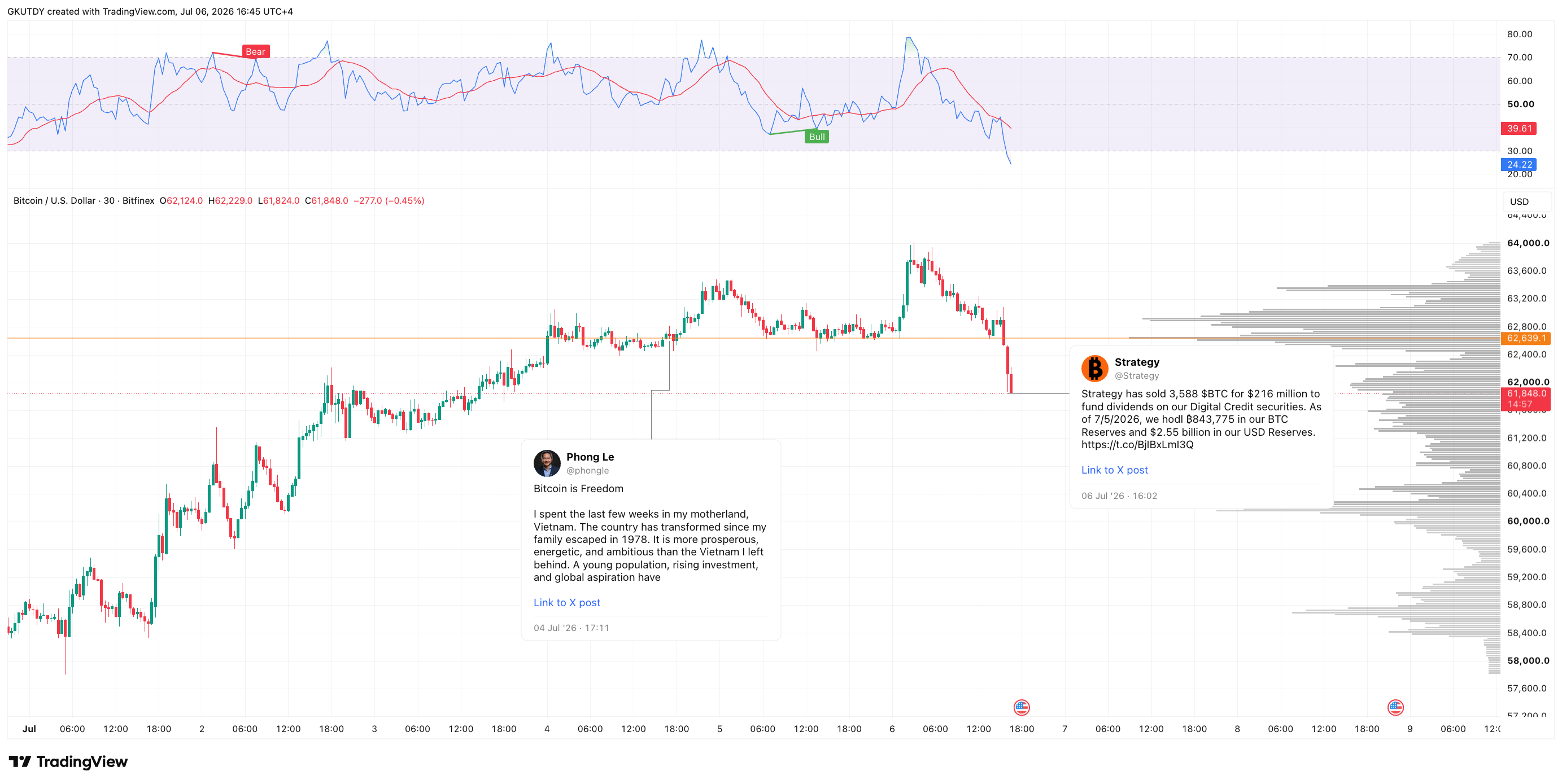
The sale brought the company $216 million in total, increasing its dollar reserves to $2.55 billion as of July 5, 2026.
At the start of the third quarter of 2026, Strategy still holds its position as the largest whale, with a balance of 843,775 BTC, while the value of its digital assets at the end of Q2 stood at $49.67 billion. At the same time, the audit revealed an accumulated unrealized loss of $8.31 billion.
The contrast between the CEO's statements about Bitcoin as a "guarantor of monetary freedom" and sales aimed at protecting financial metrics triggered skepticism among observers. On the news of growing sales from Strategy, Bitcoin fell below the psychological $62,000 mark.
Pressure from a key institutional player clearly triggered a wave of local sell-offs, forcing traders to reassess risks while corporate leadership discusses the global freedom of blockchain.
Crypto market outlook: Saylor and miner capitulation pressure Bitcoin near July's key trendlines
Bitcoin is testing the strength of the $62,000 support zone, reacting to a confirmed breakdown of the local long-term trend amid news of BTC sales by Michael Saylor. The market has frozen ahead of the FOMC minutes, which will determine whether the current sell-off turns into a full move toward $58,000 or launches a V-shaped reversal.
Key checkpoints:
- BTC/USD technical breakdown: The price impulsively broke below the support line near $62,500 with a vertical red candle, briefly dropping to $62,118. The main horizontal volume area, according to the VRVP POC, was traded higher — in the $62,600–$62,850 range — turning this zone into local resistance. Meanwhile, the RSI(14) fell to 37.73, confirming the development of downside momentum.
- Absolute miner capitulation: The miner stress index fell to 0.00, matching the lows of 2015, 2018, 2020, and 2022. The realized profit/loss ratio is at a 43-month low. The total amount of BTC held at a loss reached 10.5 million, which has historically pointed to the formation of a macroeconomic bottom.
- Macroeconomic trigger on July 7: The release of the NY Fed's consumer inflation expectations for June. A decline in the figures would strengthen the probability of Federal Reserve monetary easing after weak NFP data showed only 57,000 new jobs.
- FOMC minutes on July 8: The release of the Fed minutes will define the medium-term trend. Dovish rhetoric would trigger a short squeeze, while hawkish signals would send the price to test the key $60,000–$62,000 support zone.

 Dan Burgin
 U.Today Editorial Team
