

Disclaimer: The opinions expressed by our writers are their own and do not represent the views of U.Today. The financial and market information provided on U.Today is intended for informational purposes only. U.Today is not liable for any financial losses incurred while trading cryptocurrencies. Conduct your own research by contacting financial experts before making any investment decisions. We believe that all content is accurate as of the date of publication, but certain offers mentioned may no longer be available.

After failing to maintain multiple attempts at recovery, Shiba Inu is still struggling on the price chart, trading close to local lows. On-chain data, however, presents a more positive picture. Seven of the ten key indicators monitored for SHIB currently lean bullish, according to the most recent metrics, indicating that underlying network activity may be improving despite poor market performance.
Reduced exchange reserves
Reduced exchange reserves typically mean that there are not as many tokens up for sale right now, which lessens the selling pressure. The second metric, Exchange Netflow, which is still negative at about -64.8 billion SHIB, supports this trend. A negative netflow, which is usually an indication of accumulation, indicates that more coins are leaving exchanges than are entering them.
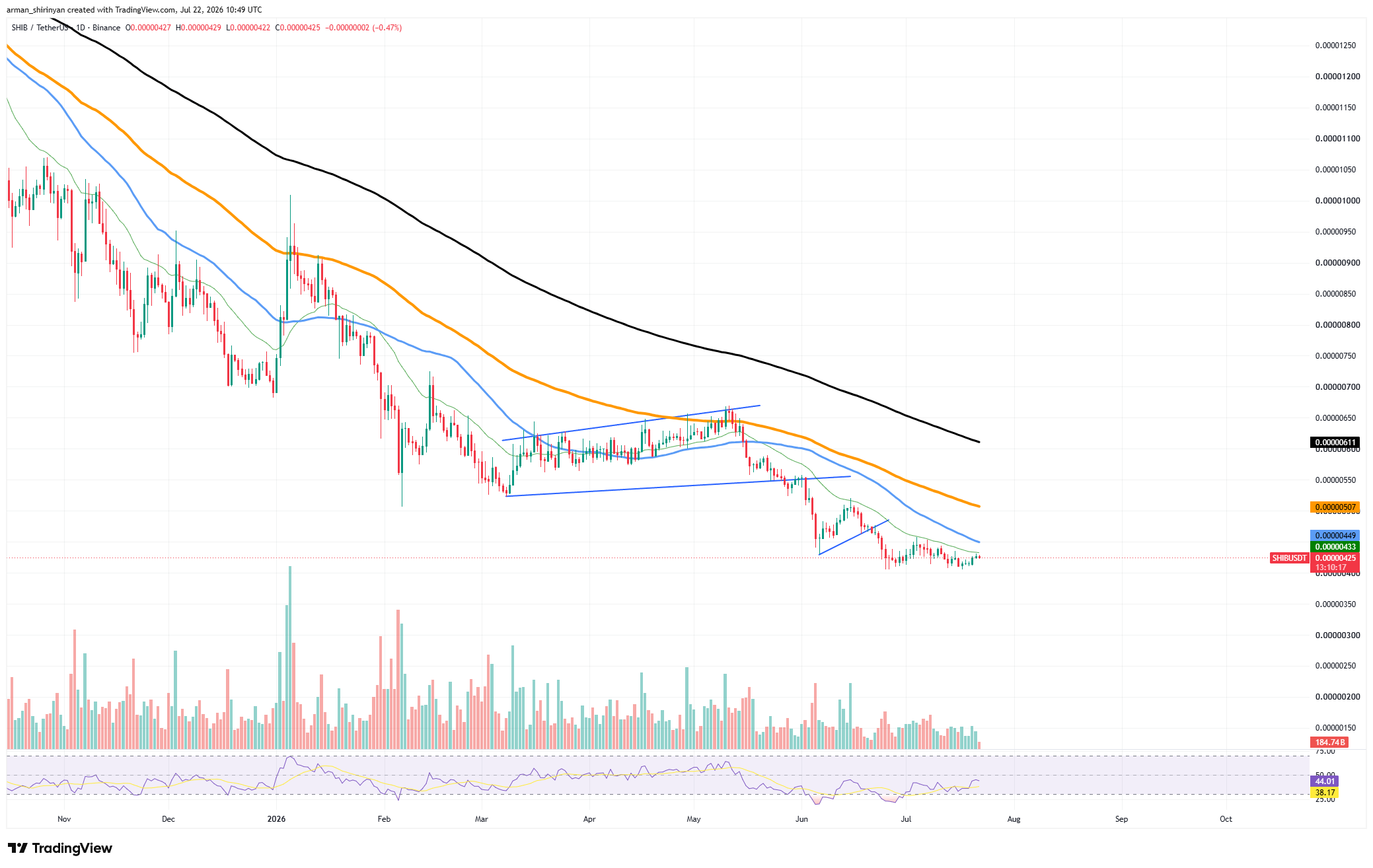
Active Addresses, which rose by more than 1% in the past day, is a third encouraging indicator. Increased address activity frequently indicates increased network participation and user engagement. Despite SHIB's decline, the slight increase implies that demand has not entirely vanished. Exchange outflow, which is greater than inflow volumes, is the fourth bullish factor.
Mean exchange flows metrics
About 250.2 billion SHIB left exchanges while 185.4 billion entered. The idea that investors are still transferring tokens into self-custody rather than getting them ready for sale is supported by this disparity. Exchange Inflow Mean and Exchange Outflow Mean are the fifth and sixth bullish metrics. The significantly higher average outflow transaction size suggests that larger holders are still taking significant amounts of SHIB out of trading platforms, even though both have increased.

On the price chart, the seventh bullish signal can be seen. The RSI for SHIB has emerged from oversold territory and is progressively rising. Momentum indicators indicate that bearish pressure is starting to lessen, even though the token is still below all major moving averages. The other three metrics are still bearish to neutral.
SHIB is still trading below its 50-day, 100-day, and 200-day moving averages, exchange reserve value in USD has decreased along with price, and exchange inflows are still high. Every significant attempt at recovery has been rejected, and the technical structure remains very bearish. However, there is a noticeable divergence between poor price action and improving on-chain data.
SHIB may be laying the groundwork for a more significant recovery once overall market conditions improve if accumulation persists and exchange balances continue to decline. Currently, on-chain participants seem far more optimistic than the chart itself indicates.
 Dan Burgin
 U.Today Editorial Team
