
Disclaimer: The opinions expressed by our writers are their own and do not represent the views of U.Today. The financial and market information provided on U.Today is intended for informational purposes only. U.Today is not liable for any financial losses incurred while trading cryptocurrencies. Conduct your own research by contacting financial experts before making any investment decisions. We believe that all content is accurate as of the date of publication, but certain offers mentioned may no longer be available.

When Shiba Inu’s burn rate suddenly increased by 2,807%, social media quickly framed it as a positive development. The number appears dramatic on paper, but in reality, it has very little bearing on SHIB's price, supply dynamics or overall market positioning.
Millions burned
Approximately 18.8 million SHIB were burned in the past 24 hours. Until you consider the context, that figure may seem impressive. However, the number of Shiba Inu tokens in circulation is measured in the hundreds of trillions.
At that scale, burning a few tens of millions of tokens is statistical noise rather than meaningful deflationary pressure. Even if this burn rate were repeated every single day, it would take decades to produce any discernible impact on supply.
Why it might not matter
That conclusion is reinforced by how the burn activity itself is structured. The transactions are small, repetitive and discretionary rather than systemic. There is no indication that large-scale supply reduction mechanisms or persistent, protocol-level burning are taking effect. This is not a hard-coded change in monetary policy or a fee-destruction model comparable to Ethereum’s. It is largely opt-in and cosmetic.

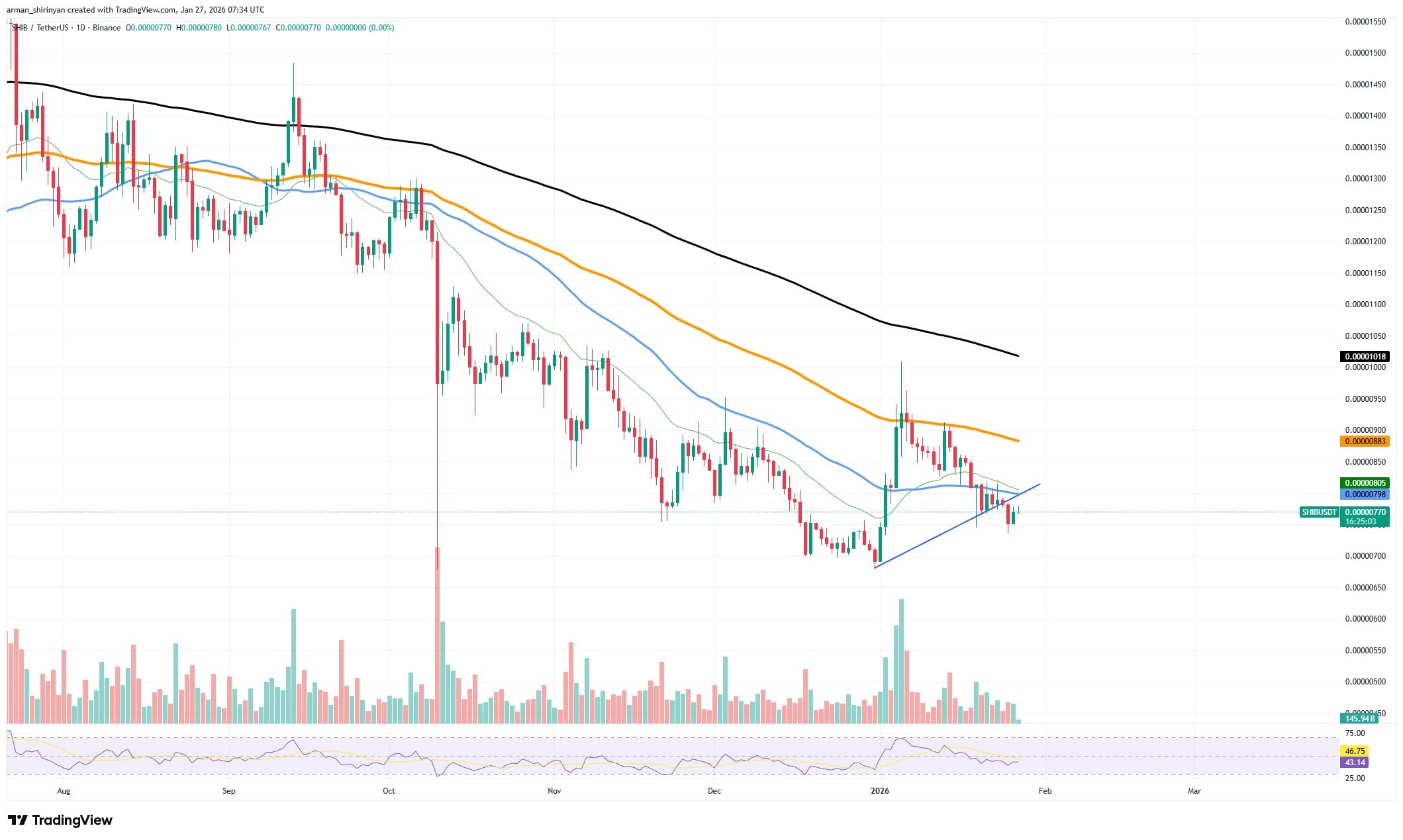
The irrelevance of the burn narrative is further confirmed by price action. SHIB continues to trade well below key moving averages and remains trapped in a broader downtrend. Volume is muted, and the most recent short-term ascending structure has already failed to produce continuation. If burn activity were actually moving the needle, the first signals would be price response and volume expansion. Neither is occurring.
More importantly, the burn narrative ignores a larger structural reality: tokenomics are subordinate to market direction. SHIB is not trading in isolation. Its price movement is tightly coupled to overall risk sentiment, liquidity conditions and Bitcoin trends. Microscopic supply reductions have no effect in an environment where altcoins are structurally weak and capital allocation is defensive.
Burn hype persists because it appeals to emotion. It creates the appearance of scarcity without requiring demand. Scarcity, however, is meaningless in the absence of buyers. A smaller pile of something does not become valuable simply because it is smaller if no one wants it.
 Dan Burgin
 U.Today Editorial Team
 Vladislav Sopov
