
Disclaimer: The opinions expressed by our writers are their own and do not represent the views of U.Today. The financial and market information provided on U.Today is intended for informational purposes only. U.Today is not liable for any financial losses incurred while trading cryptocurrencies. Conduct your own research by contacting financial experts before making any investment decisions. We believe that all content is accurate as of the date of publication, but certain offers mentioned may no longer be available.

Major global derivatives exchange CME Group has officially announced the launch of trading in futures contracts on the new Nasdaq CME Crypto Index. The main feature of the new benchmark is the inclusion of XRP, Stellar (XLM), and Chainlink (LINK) in a single regulated basket alongside Bitcoin, Ethereum, Solana, Cardano, and Bitcoin Cash.
The contracts are cash-settled based on the Nasdaq CME Crypto Settlement Price Index, allowing institutional funds to gain diversified exposure to the crypto market without the need to directly buy and custody the tokens themselves.
While skeptics argued about the long-term prospects of altcoins, Wall Street simply packaged them into a ready-made product for conservative capital.
XRP launch day: What the CME data means
According to representatives of CME Group and Nasdaq, the launch responds to clear market demand for a transparent benchmark with strict governance rules. The futures give funds the ability to manage risk within a single, familiar infrastructure of the traditional financial market.
What is most interesting is that the first steps of the new index can already be seen on CME trading screens, where the instruments are being tested by the market. Fresh terminal data shows that standard XRP futures under the ticker XRPM6 are trading at 1.1090, while the asset itself is down 3.02% on the day with a moderate starting volume of 169 contracts.
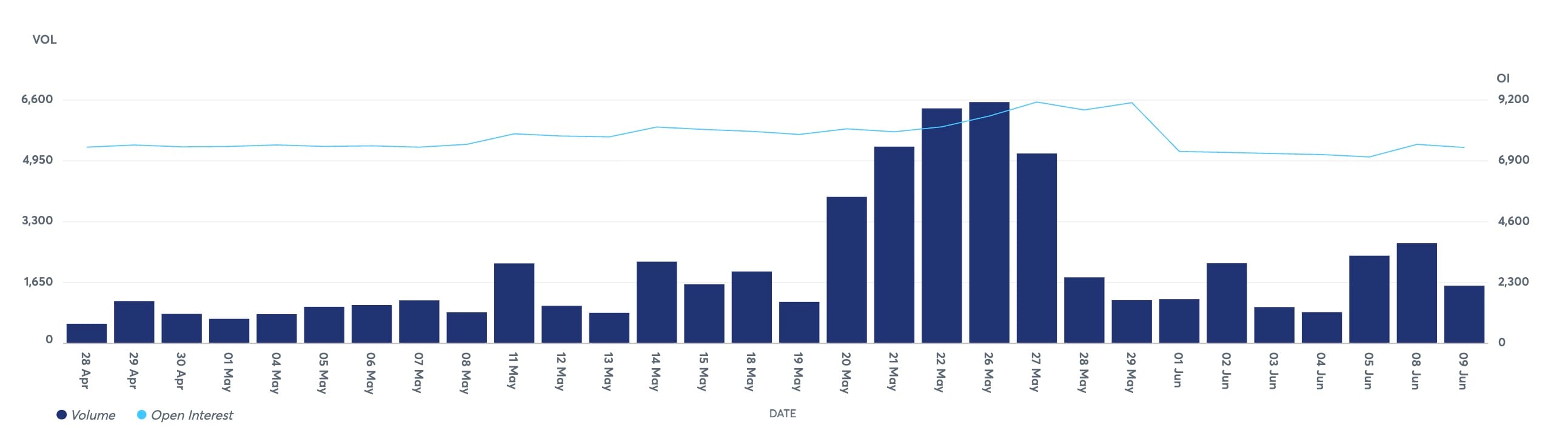

At the same time, micro XRP futures under the ticker MXPM6 are holding at 1.1105. They are down 2.89%, but show higher retail activity, with trading volume reaching 611 contracts.
This difference in figures clearly shows that, at the launch stage, the instrument is being adopted mainly by mid-sized trading firms and algorithmic traders, while larger capital is still watching the new structure.
Nevertheless, it is fair to say that despite the local price correction of around 3% on launch day, the start of trading lays a long-term foundation for the assets.
 U.Today Editorial Team
 Dan Burgin
