
Disclaimer: The opinions expressed by our writers are their own and do not represent the views of U.Today. The financial and market information provided on U.Today is intended for informational purposes only. U.Today is not liable for any financial losses incurred while trading cryptocurrencies. Conduct your own research by contacting financial experts before making any investment decisions. We believe that all content is accurate as of the date of publication, but certain offers mentioned may no longer be available.

A significant decline in network activity is indicated by recent on-chain data from XRP Ledger, with important metrics demonstrating a nearly 50% decline in a 24-hour period.
Point of attraction
Although price action frequently draws the most attention, these underlying indicators offer a more structural perspective of the network’s health, and the current picture is not very compelling. From high levels earlier in the week to about 799,000 transactions, XRP Ledger has seen a sharp decline in the number of payments processed. Instead of a gradual cooldown, this abrupt contraction points to a sudden decline in usage.
In the past, these decreases have typically been attributed to decreased involvement from both automated systems and retail users interacting with the network. The number of active accounts and users has also drastically decreased at the same time. While unique sending accounts decreased toward about 12,000, active addresses, which were previously closer to the 200,000 range, have significantly decreased.
Many people view these metrics as stand-ins for actual on-chain economic activity. Rather than being transient noise, their rapid contraction typically indicates a declining demand for the network’s utility. This type of coordinated decline across several activity indicators is concerning from the perspective of market structure. It implies that the XRP ecosystem may currently depend more on spikes in activity than on consistent participation.
Ledger is still stable
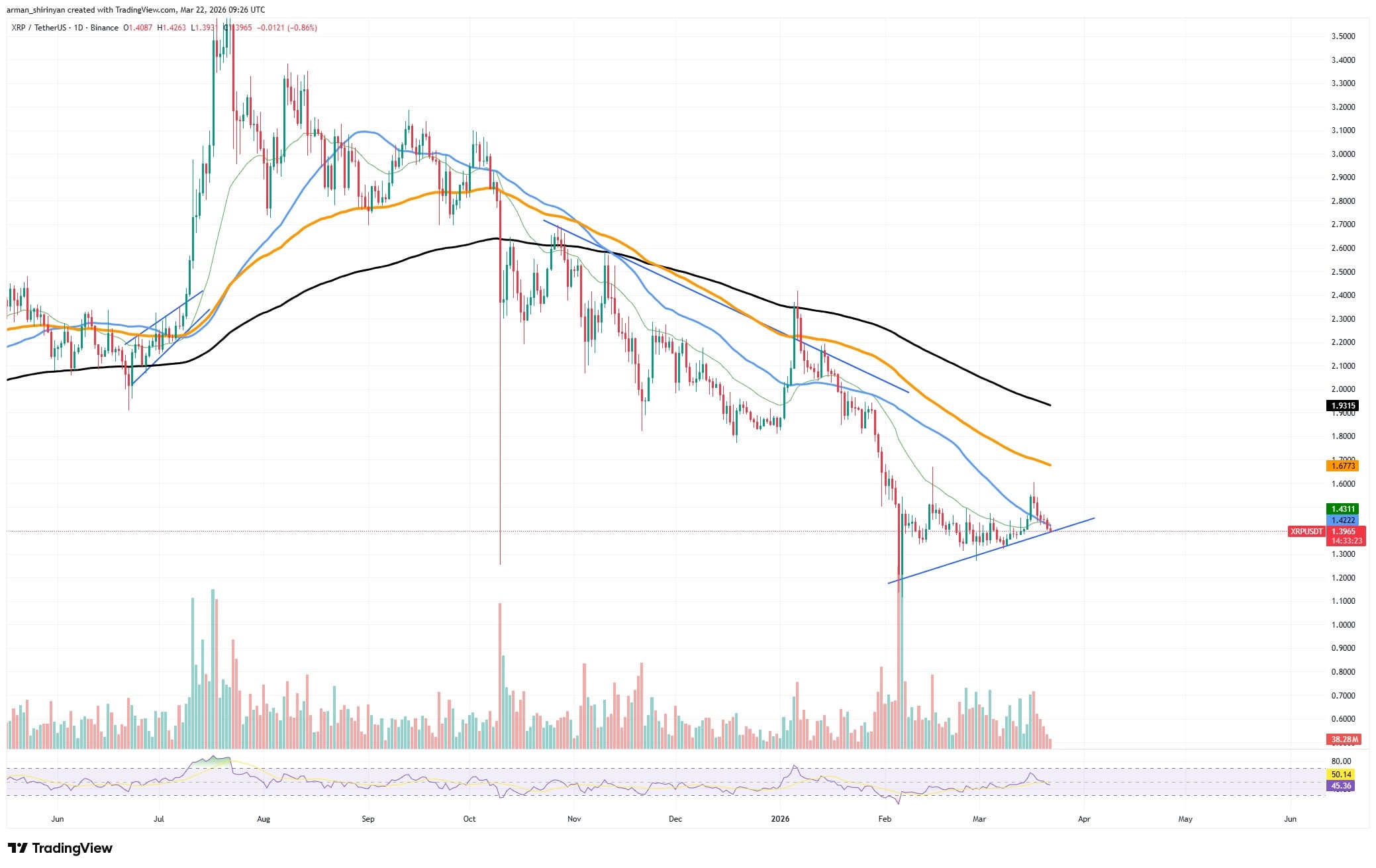
The network finds it difficult to sustain steady throughput after those spikes end, which causes usage metrics to noticeably decline. This change is starting to show in price performance. With recent attempts at recovery encountering resistance close to important moving averages, XRP is still in a more general downtrend.

The likelihood of a long-term bullish reversal is decreased when there is weak on-chain support, because organic demand doesn’t seem to be strong enough to boost momentum. It is crucial to remember that these metrics do not always point to a basic problem with XRP Ledger. Rather, they draw attention to participation and liquidity’s cyclical flaws.
Network activity frequently changes in tandem with general market conditions, especially in speculative settings. However, the recent decline’s magnitude and speed indicate that the market’s current structure is unstable.
If user activity and transaction volume don’t improve, XRP might continue to be under pressure, with price movement still reliant on transient flows rather than steady underlying demand.
 U.Today Editorial Team
 Dan Burgin
