
Disclaimer: The opinions expressed by our writers are their own and do not represent the views of U.Today. The financial and market information provided on U.Today is intended for informational purposes only. U.Today is not liable for any financial losses incurred while trading cryptocurrencies. Conduct your own research by contacting financial experts before making any investment decisions. We believe that all content is accurate as of the date of publication, but certain offers mentioned may no longer be available.

The escalation of geopolitical risks around the Middle East triggered the second-largest wave of crypto market capitulation in 2026, forcing institutional investors to withdraw $1.67 billion from funds, according to CoinShares. And while U.S. and German investors were massively locked into losses, XRP-based products remained in the green zone.
Even as weekly inflows into the token fell by 36%, the asset demonstrated clear autonomy from falling Bitcoin and Ethereum, when the three-week capital outflow from the industry reached $4.21 billion, fully erasing the optimism around regulatory progress in the U.S. CLARITY Act.
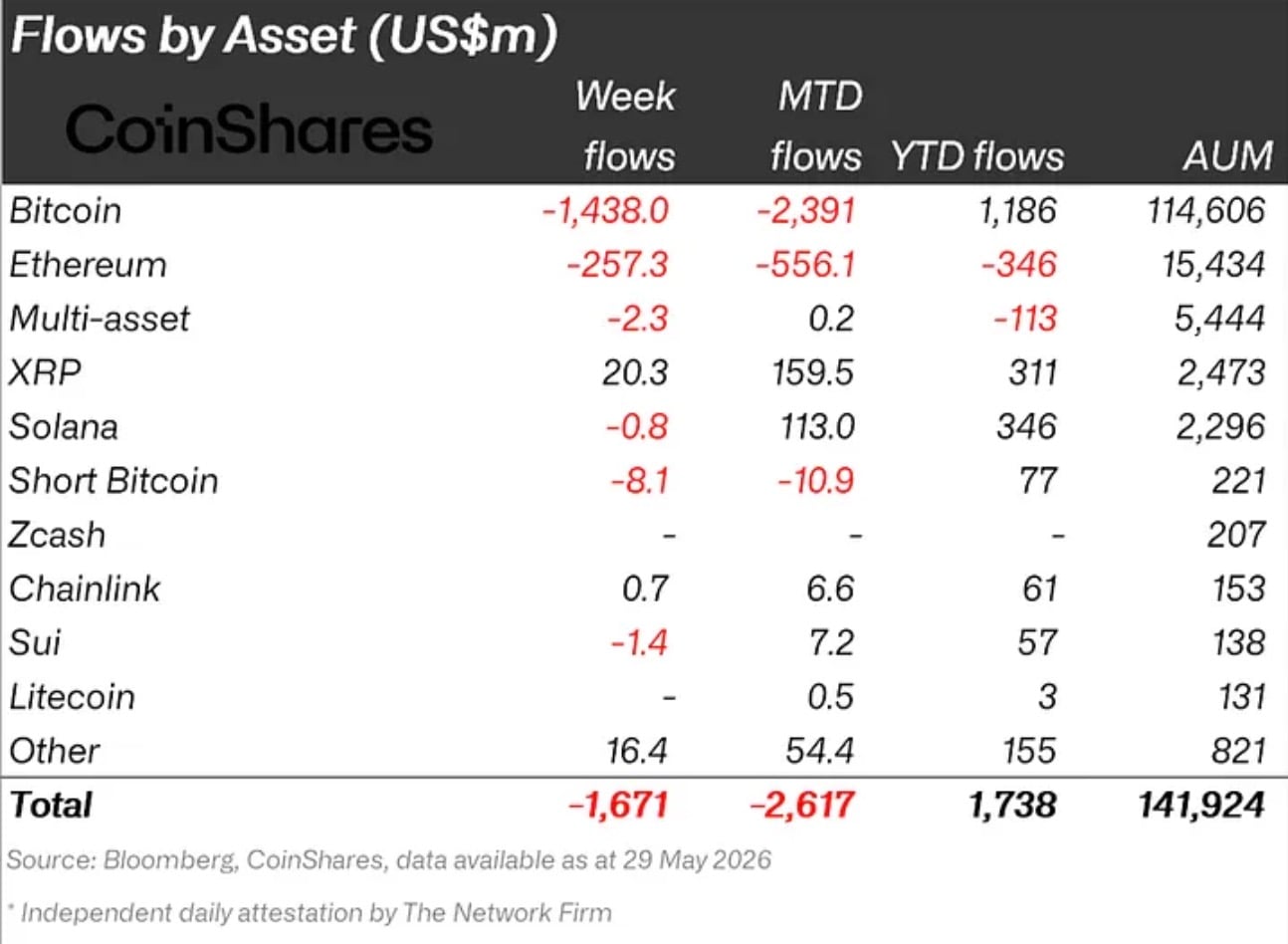
The total assets under management of crypto funds fell to $141.924 billion. The situation is starting to closely repeat the extended January decline, says James Butterfill from CoinShares, as the market contracted without interruption for five consecutive weeks.
The main pressure came from the U.S., where investors withdrew $1.63 billion.
How XRP survived a $1.67 billion crash as US and Germany yielded
One of the markers of institutional pessimism was Europe's capitulation. Germany, which had held its ground during previous market shocks until the last moment, gave in this week and recorded a net outflow of $25.7 million. Sweden also moved into negative territory with $6.6 million in outflows, along with Hong Kong at $4.5 million.
Yet, this retreat was not absolute as the Netherlands completely defied the transatlantic trend, contributing a positive counter-inflow of $1.3 million to the exchange tables.
In this deadlock, XRP became the key counterweight to the global trend. Yes, the general drought also hit Ripple's "North Star" dynamics, with inflows into XRP falling to $20.3 million from $31.8 million a week earlier.

Nevertheless, against the billion-dollar losses of the heavyweights, this result pushed the token into the absolute lead among assets resisting the sell-off, raising its year-to-date net inflows to $311 million and total assets under management to $2.473 billion.
Apart from XRP, only a handful of projects managed to hold their positions within the European contour, including Hyperliquid with $10.8 million and Near with $7.6 million.
 Dan Burgin
