
Disclaimer: The opinions expressed by our writers are their own and do not represent the views of U.Today. The financial and market information provided on U.Today is intended for informational purposes only. U.Today is not liable for any financial losses incurred while trading cryptocurrencies. Conduct your own research by contacting financial experts before making any investment decisions. We believe that all content is accurate as of the date of publication, but certain offers mentioned may no longer be available.

Zcash has experienced one of its biggest selloffs in recent memory as a result of investors' widespread concern over a critical Orchard pool vulnerability.
One of the worst sell-offs in history
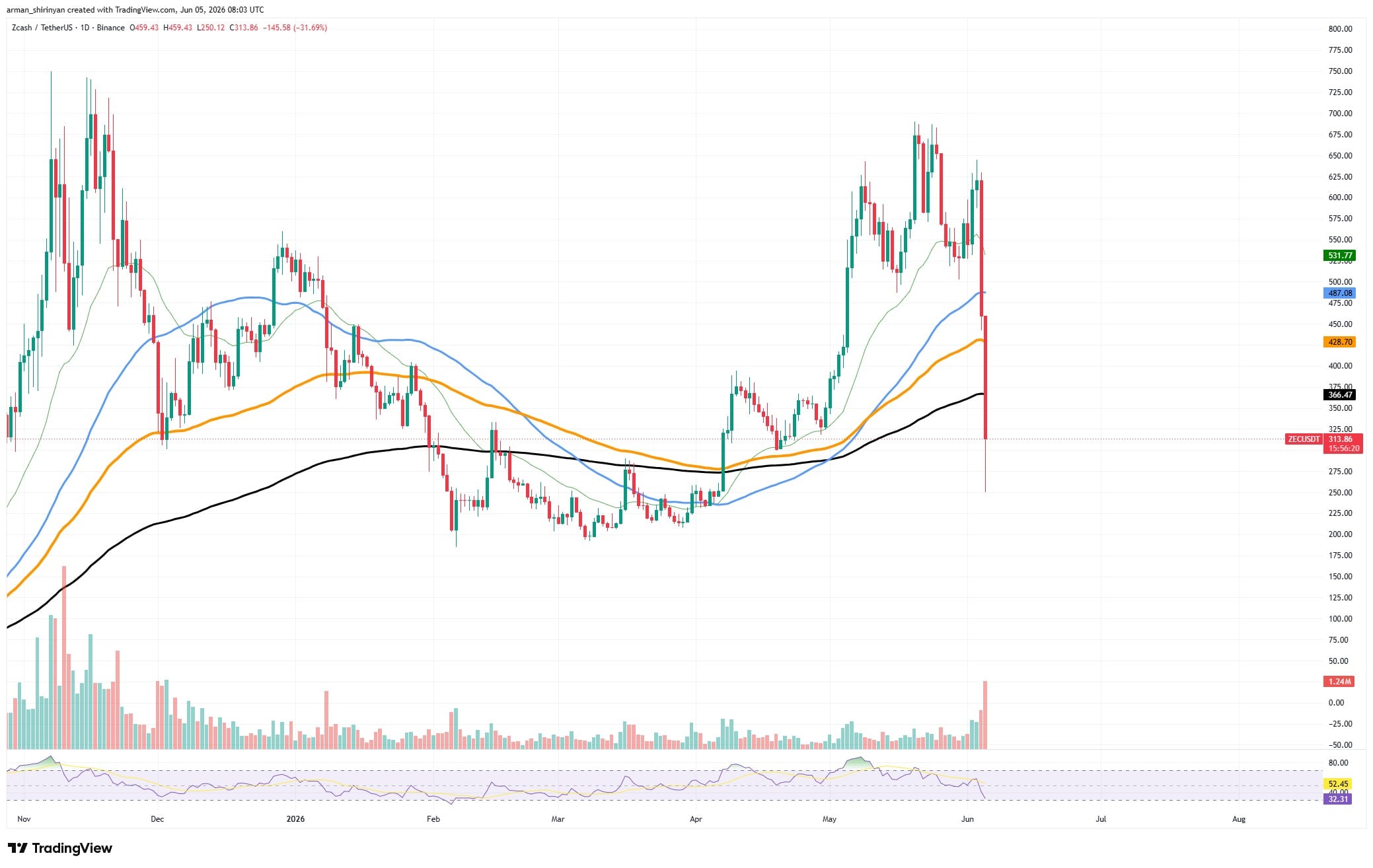
In a single session, the asset fell more than 40%, wiping out weeks' worth of gains as traders hurried to reevaluate the network's risk profile.
Confirmation that a bug affecting the Orchard shielded pool existed from May 2022 until it was fixed on June 1 is the source of the controversy. Discussions within the Zcash community indicate that the vulnerability might have made it possible to create counterfeit ZEC, which would have been very challenging to identify due to the pool's privacy-preserving features.
For many investors, the problem is fundamental to Zcash's value proposition. Cryptographic guarantees are crucial to privacy systems, and supply integrity uncertainty naturally raises concerns. That reality is reflected in the market's response.
The worst part
The most crucial information is that a patch has already been applied to the vulnerability. Moreover, as of right now, there is no proof that the vulnerability was ever exploited. Cryptographically proving that no counterfeit coins were produced may be impossible, but it is also impossible to show that exploitation took place. Without concrete evidence that the worst-case scenario truly occurred, the market is essentially pricing in a worst-case scenario.

Because of this, the selloff's magnitude may eventually turn out to be excessive. One could contend that the economic consequences would have probably already become apparent if a skilled attacker had found and exploited the vulnerability during the three-year window in which it existed. Market behavior, liquidity flows, or supply dynamics are often affected by widespread hidden inflation. However, ZEC had not encountered any glaring irregularities that would strongly suggest catastrophic abuse prior to the revelation.
Technically speaking, the chart no longer shows a slow repricing but rather capitulation. The price simultaneously fell through multiple significant support zones as volume surged to local heights.
Whether developers can rebuild trust through transparency, audits, and ongoing incident analysis will determine the course of recovery. The current collapse may eventually be seen as an emotional overreaction rather than a long-term devaluation of the network if the community is persuaded that there was no significant exploitation.
 Dan Burgin
 U.Today Editorial Team
