
Disclaimer: The opinions expressed by our writers are their own and do not represent the views of U.Today. The financial and market information provided on U.Today is intended for informational purposes only. U.Today is not liable for any financial losses incurred while trading cryptocurrencies. Conduct your own research by contacting financial experts before making any investment decisions. We believe that all content is accurate as of the date of publication, but certain offers mentioned may no longer be available.

The search for a "private Bitcoin" has been one of crypto's longest-running quests. Monero offered ring signatures. Zcash introduced zero-knowledge proofs. But both made trade-offs that moved them further from Bitcoin's core design philosophy. One project took a different path entirely — and the result is closer to Bitcoin than anything else in the market. Epic Cash launched in September 2019 with a radical premise: keep everything that makes Bitcoin great, fix the one thing that doesn't work, and change nothing else.
Same DNA, Different Privacy Model
Bitcoin's architecture is elegant but transparent. Every transaction is broadcast to the network, stored permanently on a public ledger, and linkable through chain analysis. This transparency was a design choice, not a requirement. Satoshi Nakamoto even acknowledged the privacy limitations in the original whitepaper, recommending that users generate new addresses for each transaction.
Epic Cash uses Mimblewimble, a protocol that achieves consensus and prevents double spending without requiring a transparent transaction history. In a Mimblewimble blockchain:
- No addresses exist on-chain. Transactions are constructed interactively between sender and receiver.
- Amounts are hidden using Pedersen commitments — a cryptographic technique that proves the math is correct without revealing the numbers.
- Transaction graph is invisible. Inputs and outputs are aggregated, making it impossible to trace the flow of funds.
- The blockchain stays compact. Spent outputs can be pruned, keeping the chain dramatically smaller than Bitcoin's.
The result is a blockchain where every transaction is private by default — not optionally, not through a mixing service, not through a second layer. Privacy is baked into the consensus mechanism itself.
Bitcoin's Emission Model — Exactly
Epic Cash did not invent a new token economics model. It copied Bitcoin's. Precisely.
- Maximum supply: 21 million EPIC
- Block reward halving: Same schedule as Bitcoin
- Inflation curve: Identical to BTC
- Distribution: 100% proof-of-work mined. No premine. No ICO. No founder allocation. No venture capital round.
This is not a minor detail. In a market where the vast majority of cryptocurrency projects allocated 10–40% of supply to insiders before a single block was mined, Epic Cash's fair launch is a statement of values. Every EPIC in circulation was earned through computational work — exactly as Satoshi intended for Bitcoin.
Three Algorithms, Maximum Decentralization
Bitcoin mining has become an industrial operation dominated by ASIC manufacturers. Epic Cash took a different approach, implementing a hybrid proof-of-work system with three mining algorithms:
- RandomX — The same algorithm used by Monero, optimized for CPU mining. Anyone with a computer can mine.
- ProgPow — GPU-optimized mining, allowing gamers and GPU owners to participate.
- Cuckoo Cycle — A memory-bound algorithm that is ASIC-resistant by design.
Each algorithm mines a percentage of blocks, ensuring that no single hardware class dominates the network. This is arguably more decentralized than Bitcoin's mining ecosystem, which is concentrated among a handful of ASIC manufacturers and large mining operations.
Five Years of Unbroken Operation
Epic Cash has been running since September 2019 with:
- 100% uptime since March 2021 — no chain halts, no rollbacks, no emergency patches in over five years
- Continuous development — with EPICT, a tokenization framework, currently in development.
The network was created by Max Freeman, who eschewed the typical crypto "founder" model — no social media presence cultivated for token pumps, no speaking tour, no VC fundraising. The project was simply released into the world and allowed to grow on its own merits.
Why "Privacy Alternative to Bitcoin" Matters Now
The narrative around Bitcoin privacy is shifting rapidly. In March 2026 alone:
- Chamath Palihapitiya declared at the World Government Summit that Bitcoin "fails on privacy and fungibility," making it unsuitable as a central bank reserve asset.
- Ray Dalio said on the All-In Podcast: "Bitcoin does not have privacy. Any transactions can be monitored."
Arthur Hayes predicted privacy would be the "dominant narrative" of the 2026 crypto cycle, making Zcash his fund's second-largest holding.
The question is no longer whether Bitcoin needs a privacy-preserving counterpart. It is which privacy-preserving cryptocurrency best embodies Bitcoin's original values. When you compare the field: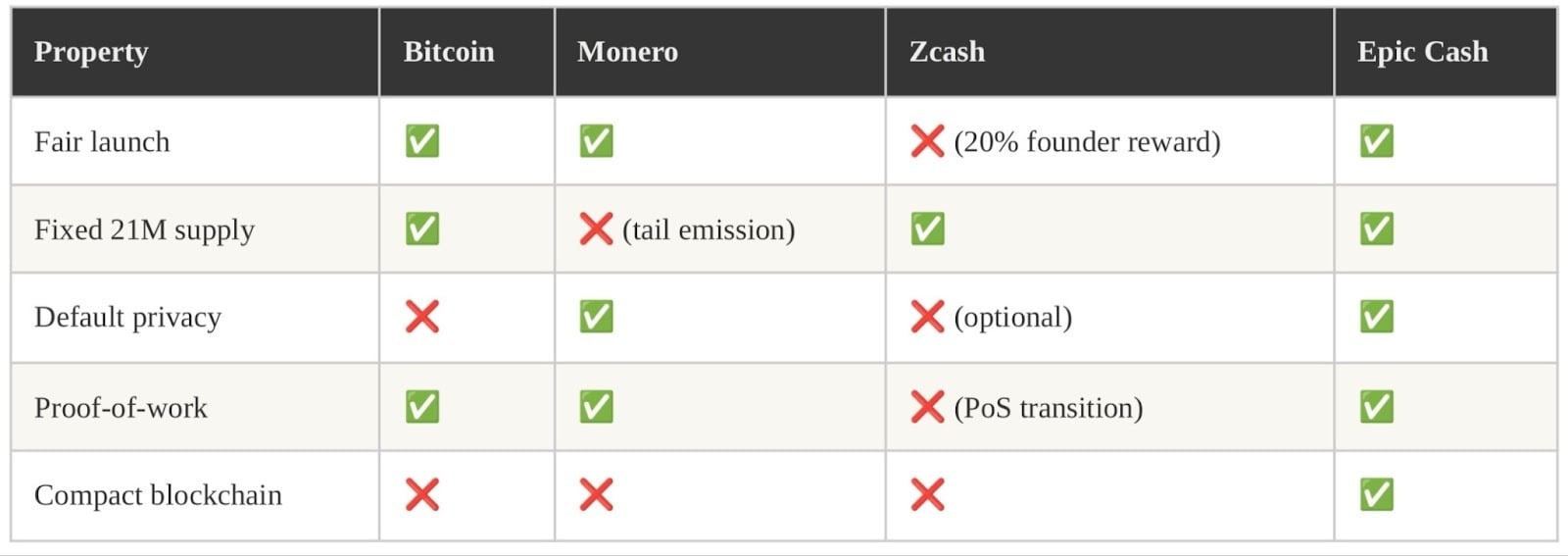
Image by Epic Cash
Epic Cash is the only cryptocurrency that combines all five properties. It is, by design, what Bitcoin would look like if it were built today with privacy as a first principle.
Where to Get EPIC
Epic Cash currently trades on NonKYC.io and CoinEx Exchange. Information about the project, its technology, and its roadmap is available at epiccash.com.
For investors seeking exposure to the privacy narrative that Chamath, Dalio, and Hayes have all identified — with the same fair-launch ethos that made Bitcoin revolutionary — Epic Cash deserves serious consideration.
 U.Today Editorial Team
 Dan Burgin
