

Disclaimer: The opinions expressed by our writers are their own and do not represent the views of U.Today. The financial and market information provided on U.Today is intended for informational purposes only. U.Today is not liable for any financial losses incurred while trading cryptocurrencies. Conduct your own research by contacting financial experts before making any investment decisions. We believe that all content is accurate as of the date of publication, but certain offers mentioned may no longer be available.

Solana's price is essentially unchanged despite a significant increase in derivatives activity, which could lead to a much more volatile next move. The volume of SOL futures has more than doubled over the past day on a number of major exchanges, but the positioning data that goes along with it suggests that there may be another price decline.
Solana gains more fat
Binance reported a 24-hour SOL futures volume of about $890 million, up 144.8%. Bybit added 108.6 percent, while OKX's volume rose by 146.1%. Increases of about 154%, 210%, and 168%, respectively, were seen on Gate, Bitget, and Hyperliquid.
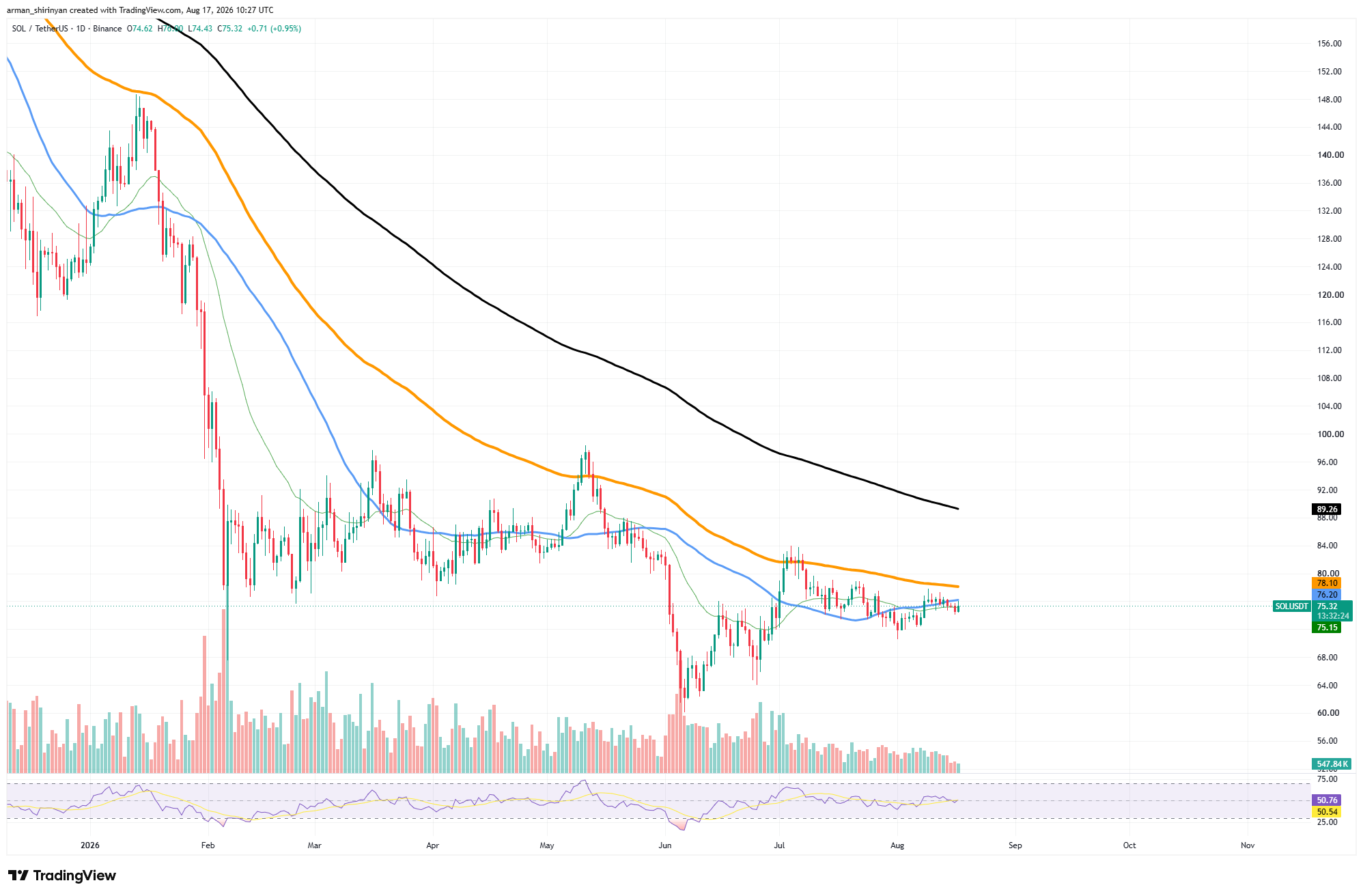
However, SOL's 24-hour performance is essentially flat and it is still close to $75.30. The discrepancy suggests that increased trading activity has not resulted in strong directional demand. Additionally, positioning has a strong long bias. Whereas OKX reports 2.42, the Binance account long/short ratio is roughly 2.43.
At 2.71, Binance's top-trader account ratio is even higher. Although this positioning does not guarantee a decline, it makes SOL more vulnerable to liquidation in the event that it loses support. Liquidation data already show that risk. About $6.07 million in SOL positions, including $4.60 million in longs and $1.47 million in shorts, were liquidated over the course of a day.

The chart offers yet another reason to exercise caution. SOL remains below the intermediate moving average at about $78.10 and trades close to $75.30. More significantly, the long-term moving average is still considerably higher at $89.26, indicating that the overall structure remains weak.
Short-term levels are formed
Short-term support is between $74 and $75. If selling picks up speed, losing this area could expose SOL to another move toward $70-$72, followed by the lows of July and August. However, if buyers regain control, the volume expansion could be beneficial.
The first more compelling sign that higher participation is encouraging accumulation rather than speculative leverage would be a persistent break above $78–$80. For the time being, however, crowded long positioning and increased futures activity are creating asymmetric risk.
If SOL does not break out to support the leverage being built around it, some of those new positions may be forced out of the market by another retrace.
 Dan Burgin
 U.Today Editorial Team
