

Disclaimer: The opinions expressed by our writers are their own and do not represent the views of U.Today. The financial and market information provided on U.Today is intended for informational purposes only. U.Today is not liable for any financial losses incurred while trading cryptocurrencies. Conduct your own research by contacting financial experts before making any investment decisions. We believe that all content is accurate as of the date of publication, but certain offers mentioned may no longer be available.

Shiba Inu is going through another challenging time as buyers fight to regain control and market activity continues to decline. Even though the cryptocurrency market as a whole is still under pressure, SHIB is exhibiting especially worrisome signs as on-chain and technical indicators suggest that investor confidence is waning.
Shiba Inu is in well-established downtrend
Trading activity is the most concerning indication. For an asset that used to frequently record multi-trillion-token trading sessions, SHIB's volume over the last 24 hours was a pitiful 438 billion tokens. This low level of participation indicates that speculative interest is waning, making the market susceptible to additional declines. SHIB is still trading within a well-established downtrend on the chart.
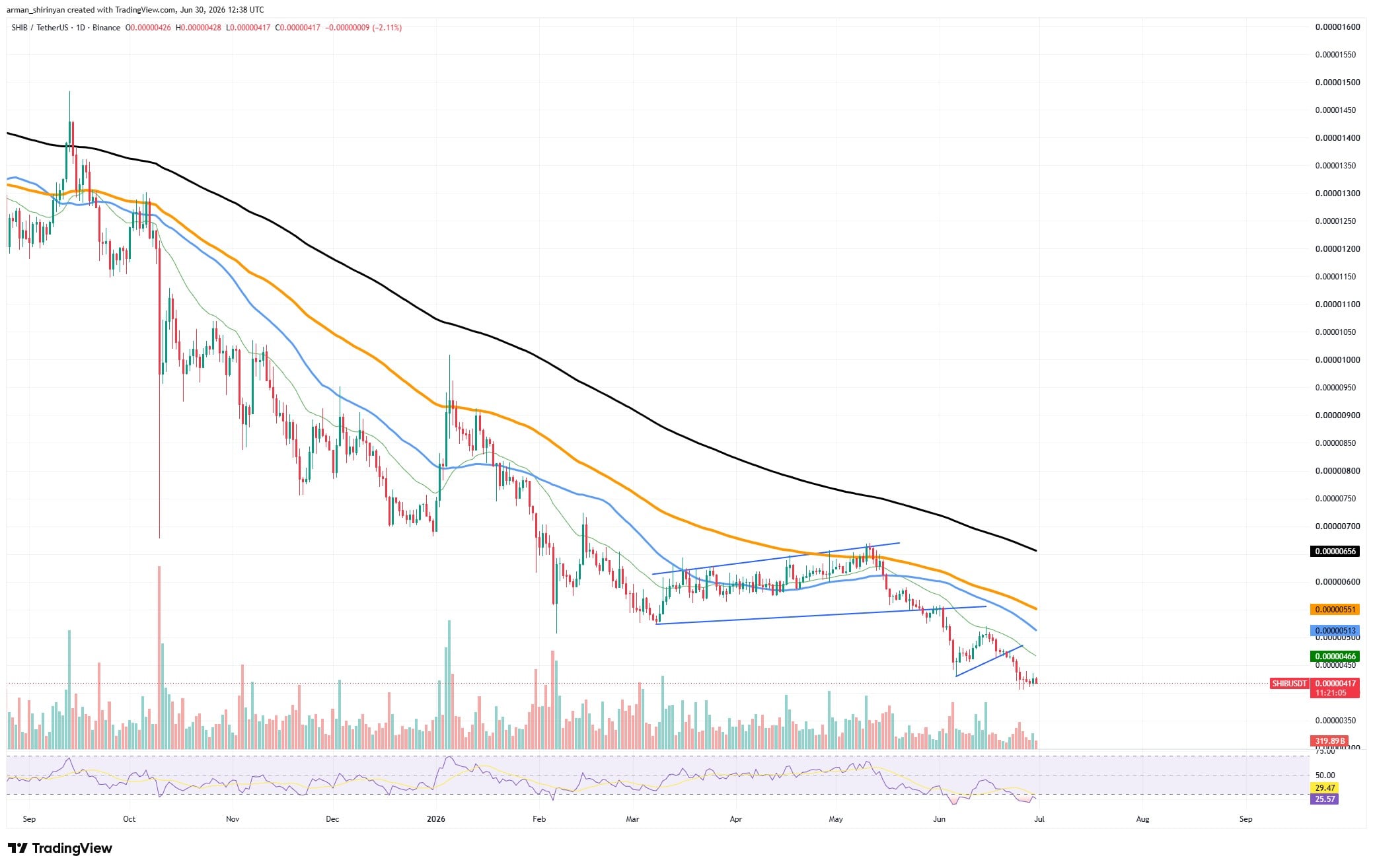
One of the few remaining bullish structures on the daily timeframe was eliminated when the asset recently broke below a short-term consolidation pattern that had emerged throughout June. SHIB fell toward the $0.0000042 region after the breakdown and is still below all major moving averages as of right now. There are several layers of resistance because the 50-day, 100-day, and 200-day moving averages are all above the current price.
Agressive stance has been taken
There will probably be a lot of selling pressure on any recovery attempt until SHIB is able to recover at least the short-term average. Data on market flow presents an equally pessimistic picture. Spot markets have consistently seen net outflows, but futures flows are still erratic and weak. More significantly, liquidations have been virtually nonexistent, suggesting that neither bulls nor bears have taken an aggressive stance.

Markets frequently enter periods of stagnation when both leverage and volume decline at the same time. These periods typically end in favor of the dominant trend, which is still negative for SHIB. There is little relief from on-chain metrics. Although active addresses and transaction counts are still too low to counteract the overall drop in market participation, exchange reserves are still trending lower, which is generally seen as positive.
There is activity in exchange inflows and outflows, but there is no obvious indication of significant accumulation that could buck the current trend. Weak market participation, a declining technical structure, and collapsing volume all point to bulls progressively losing control.
 U.Today Editorial Team
 Dan Burgin
