

Disclaimer: The opinions expressed by our writers are their own and do not represent the views of U.Today. The financial and market information provided on U.Today is intended for informational purposes only. U.Today is not liable for any financial losses incurred while trading cryptocurrencies. Conduct your own research by contacting financial experts before making any investment decisions. We believe that all content is accurate as of the date of publication, but certain offers mentioned may no longer be available.

Almost 700 billion SHIB moved onto trading platforms in a single day, marking one of Shiba Inu's biggest exchange inflow spikes in the last month.
Although significant inflows are frequently linked to increasing selling pressure, the size of the most recent movement shows that despite its prolonged decline, SHIB is still one of the most actively traded meme assets.

On-chain data indicates that on June 2, SHIB's Exchange Inflow (Total) increased to roughly 699.3 billion tokens, the highest single-day inflow in the previous 30 days. The spike came as SHIB continued to hover close to local lows and greatly outpaced the average daily inflows observed throughout May.
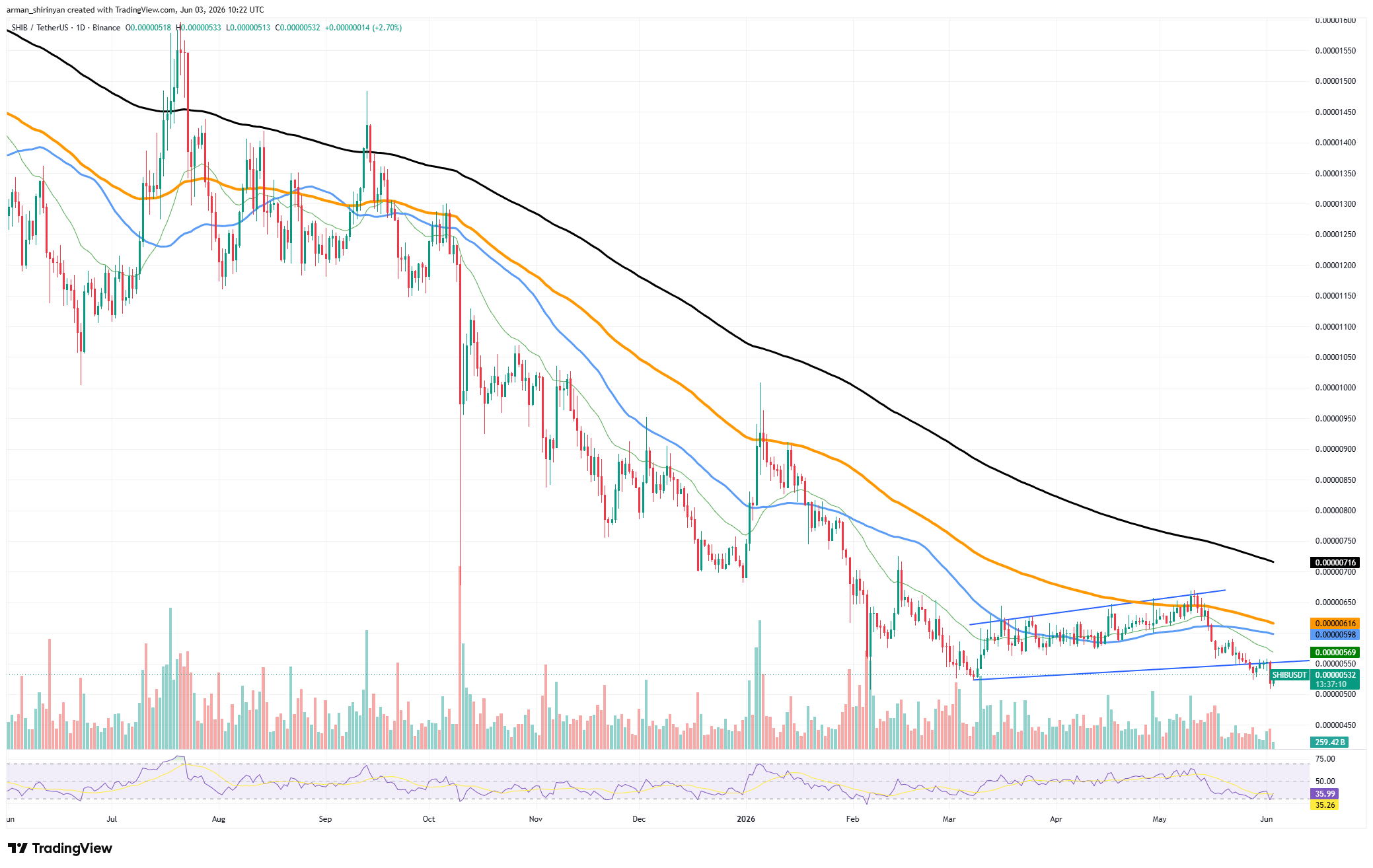
Especially noteworthy is the timing of the inflow event. A multi-month rising support line that had been holding the asset since March was recently broken by SHIB on the price chart. The token was driven toward the $0.0000052-$0.0000053 range by another wave of selling pressure brought on by the breakdown.
A significant transfer of assets to exchanges typically indicates that market players are getting ready to sell. However, inflows by themselves do not always indicate that the market will remain bearish. Increased speculation, position rotation, or large-scale accumulation by traders getting ready for increased volatility can also be accompanied by increased exchange activity.
Reservers keep up the pressure
However, more comprehensive exchange metrics continue to indicate a seller-dominated market. While exchange reserves continued to rise toward 80.5 trillion SHIB, total exchange inflows surpassed 631 billion SHIB. Greater reserves typically mean that there are more tokens available for instant trading, which lowers scarcity and raises the possibility of sell-side pressure.
SHIB is still stuck below its key moving averages from a technical standpoint. While the 200-day moving average is still significantly above the current market price, the 50-day and 100-day moving averages continue to function as dynamic resistance.
The overall trend is still clearly bearish, but momentum indicators are getting close to oversold territory, which might allow for a brief relief bounce.
Now, the most crucial question is whether the 669 billion SHIB inflow is a sign of surrender or of getting ready for another distribution wave. SHIB could stabilize and try to recover if buyers are able to absorb the incoming supply. If not, the most recent capital infusion could serve as more evidence that bears continue to dominate the market and that further declines are still possible in the coming weeks.
 Dan Burgin
