

Disclaimer: The opinions expressed by our writers are their own and do not represent the views of U.Today. The financial and market information provided on U.Today is intended for informational purposes only. U.Today is not liable for any financial losses incurred while trading cryptocurrencies. Conduct your own research by contacting financial experts before making any investment decisions. We believe that all content is accurate as of the date of publication, but certain offers mentioned may no longer be available.

After months of relentless selling pressure, Shiba Inu may finally be stabilizing. A significant on-chain development has drawn traders' attention even though SHIB is still mired in a wider downtrend: roughly 148.7 billion SHIB tokens have left exchanges, resulting in one of the biggest recent negative netflow readings.
Shiba Inu netflows are finally negative
On-chain data indicates that SHIB's exchange netflow is currently at -148.7 billion tokens. Negative netflows usually mean that there are fewer tokens available for immediate sale because more tokens are being taken out of exchanges than are being deposited. A single day of outflows does not always indicate a reversal, but it frequently indicates that investors are feeling better and are more inclined to hold than sell.
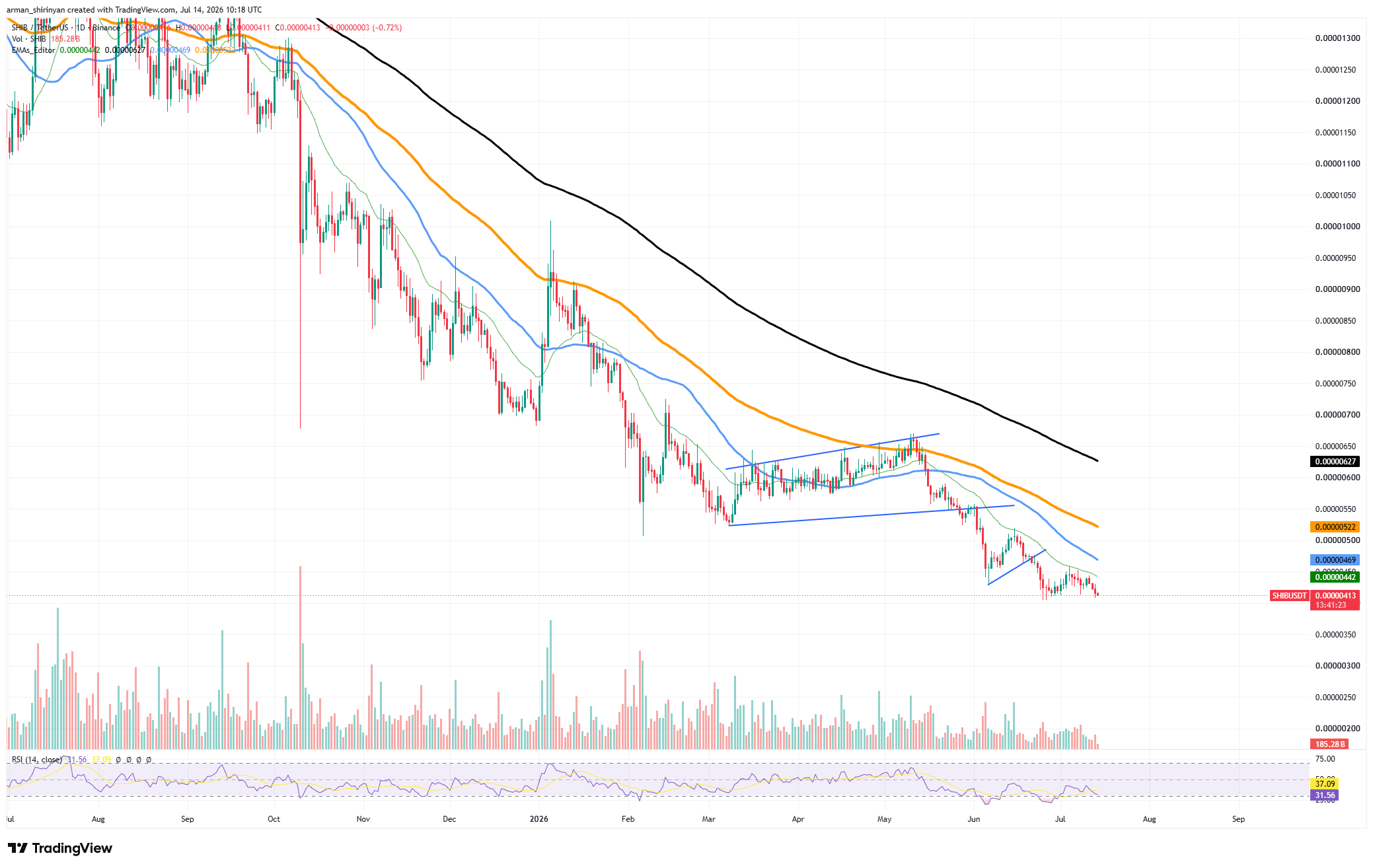
Since SHIB has been under pressure for the majority of the year, the timing of the action is especially intriguing. The token has lost nearly 69% over the past 12 months and more than 40% so far this year. Due to this performance, a lot of speculative traders have left the market, resulting in comparatively low levels of activity. That observation is supported by the technical picture. SHIB recently broke down from a rising wedge formation on the daily chart, which at first looked bearish.
Selling momentum is weakening
The subsequent selling momentum, however, has been surprisingly weak. Volume is still dropping, and sellers are becoming less involved with every new push lower. Put differently, the downward trend is getting more and more hollow. This is frequently a crucial feature close to market bottoms. Rarely do significant reversals start at the height of panic.
Rather, they usually appear after long stretches of fatigue, when sellers have mostly finished distributing and new negative catalysts are hard to come by. While its RSI is still in the vicinity of oversold territory, SHIB is also trading close to historically significant support levels. The lack of strong selling pressure is becoming more apparent, even though buyers have not yet created a clear breakout above the short- and medium-term moving averages.

The exchange flow data gives the narrative an additional level of complexity. Exchange reserves continue to decline in tandem with the 148.7 billion SHIB net outflow, indicating that some investors are transferring assets into self-custody rather than getting them ready for sale.
SHIB is still technically bearish as of right now. However, the market may be preparing for the first significant bullish reversal signal in months due to a combination of declining exchange supply, waning sell-side momentum, and an increasingly worn-out downtrend.
 Dan Burgin
 U.Today Editorial Team
