

Disclaimer: The opinions expressed by our writers are their own and do not represent the views of U.Today. The financial and market information provided on U.Today is intended for informational purposes only. U.Today is not liable for any financial losses incurred while trading cryptocurrencies. Conduct your own research by contacting financial experts before making any investment decisions. We believe that all content is accurate as of the date of publication, but certain offers mentioned may no longer be available.

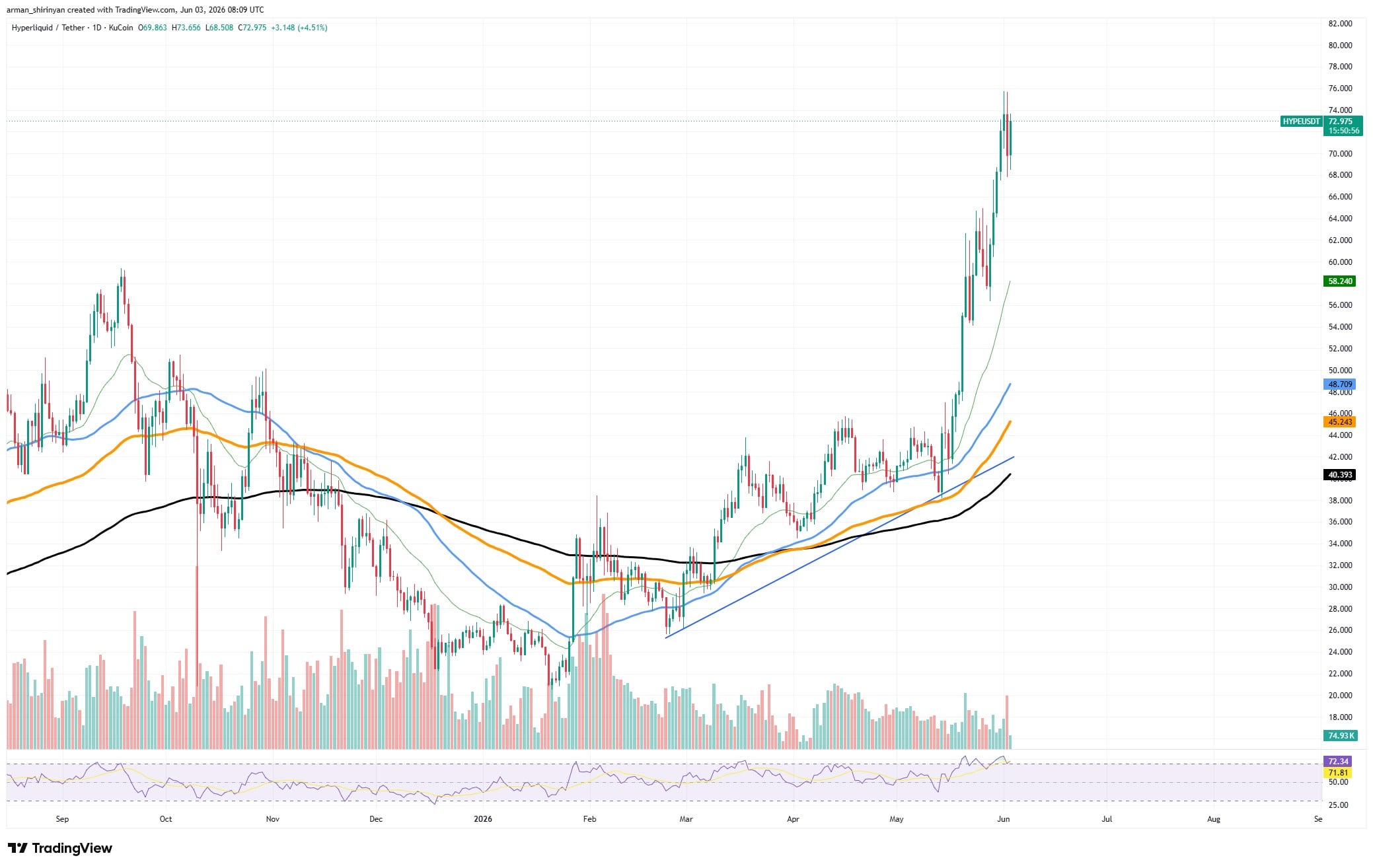
The entry of Hyperliquid into prediction and event-based markets has gotten off to an incredibly good start. In their first full month of operation, the platform's HIP-4 event contracts generated over $92 million in trading volume, according to recently released data. This indicates significant early demand for a product category that many investors still consider experimental.
Hyperliquid's volumes surge
In light of the market offering's narrow scope, the numbers are striking. HIP-4 contracts averaged about $3 million in daily volume, with about $92 million traded during May. That level of activity indicates traders are actively searching for alternatives to conventional prediction market platforms for a recently introduced product with only a few available markets.
But the ecosystem is still very concentrated right now. The majority of trading activity occurs through event contracts related to Bitcoin, and the overall catalog of markets is still quite small. As a result, growth is dependent on both increasing the number of users and the variety of events that can be speculated on.
Dominating the ecosystem
Hyperliquid is progressively positioning itself against multiple industries at once. Although prediction markets are dominated by platforms such as Polymarket, Hyperliquid already has control over one of the biggest decentralized perpetual futures ecosystems in cryptocurrency. By successfully merging those domains, HIP-4 enables the platform to go beyond trading only derivatives.
The long-term effects might be substantial. Decentralized infrastructure can directly compete with centralized exchanges in terms of liquidity and user experience, as Hyperliquid has already shown. If HIP-4 keeps gaining popularity, it may eventually pose a significant threat to major trading venues, as well as prediction market operators.

Some market players have even started debating whether Hyperliquid could eventually overthrow industry titans like Binance. The growth trajectory is hard to ignore, even though that scenario is still far off.
In addition to generating significant protocol revenue and continuously gaining market share in perpetual futures, Hyperliquid now seems capable of expanding its user base to include completely new product categories.
The contrast between Polymarket and Hyperliquid is getting more and more intriguing. While one is investigating decentralized trading infrastructure, the other is delving deeper into prediction markets. In the end, both platforms might move into each other's territory rather than engage in direct competition.
For the time being, HIP-4's first month makes it very evident that there is a genuine need for on-chain event markets, and Hyperliquid plans to rise to the top of the industry.
 Dan Burgin
