

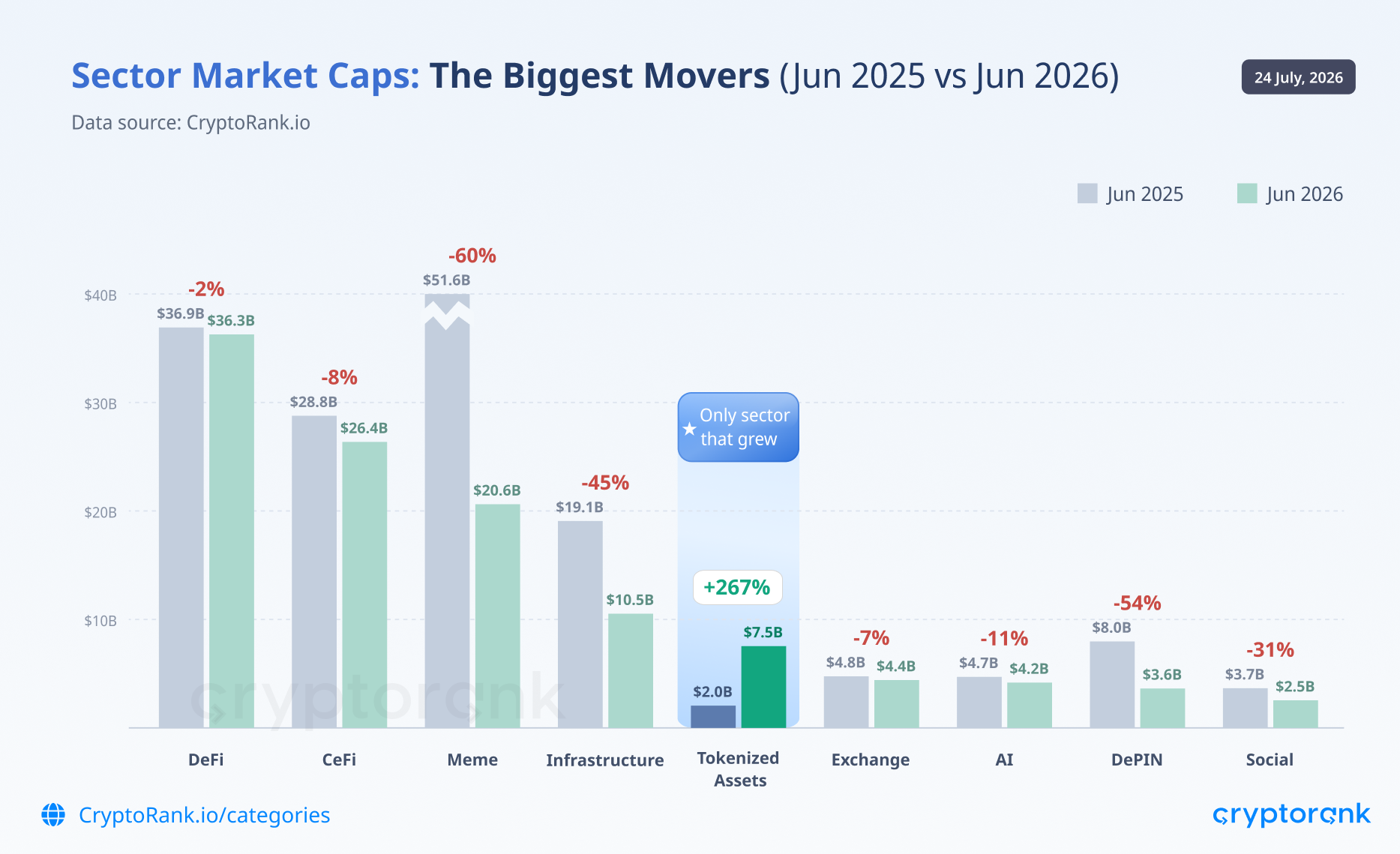
The past year was difficult for crypto markets. Prices declined across most sectors, but losses were uneven. While speculative categories gave back much of their previous gains, one segment moved in the opposite direction. Between June 2025 and June 2026, tokenized assets were the only major crypto sector to increase in market capitalization, growing 267%.
Tokenization of precious metals
Unlike most crypto sectors, this expansion was driven by new issuance rather than rising token prices. Gold remained the foundation of the category. The metal appreciated by nearly 20% over the year, while the amount of tokenized gold held on-chain nearly doubled, increasing from about 524,000 ounces to more than one million ounces. As a result, tokenized gold continued to account for most of the sector's value.
Source: CryptoRank
The biggest structural change, however, came from tokenized equities. One year earlier, stocks and ETFs had virtually no presence in the sector. By June 2026, they represented 23% of total tokenized assets.
Shares of major public companies and index products became available through platforms including Ondo, bStocks, gStocks, and xStock. The remainder of the sector consists of tokenized Treasuries, private credit, and a small allocation to crypto ETFs.
Every other major crypto sector contracted over the same period. Memecoins experienced the largest decline after being one of the market's biggest speculative themes a year earlier. DePIN and infrastructure also posted steep losses, while most remaining sectors declined more gradually without experiencing the same sharp collapse.
Tokenized assets dominate the scene
For most of the past year, tokenized assets were almost entirely represented by precious metals. Tether Gold (XAUT) and PAX Gold (PAXG) made up the majority of the market, with precious metals accounting for nearly 100% of openly traded tokenized assets in mid-2025. By June 2026, that share had fallen to 68% as equities expanded rapidly.
Issuance is concentrated among a small number of providers. Measured by token count, rStocks and Ondo account for roughly two-thirds of all tokenized equities. rStocks has issued more than 560 tokenized instruments, while Ondo offers over 400, including single-company stocks such as NVIDIA and Apple alongside products tracking broad market indices like the S&P 500.
The category also expanded through centralized exchanges. Binance launched bStocks in June 2026, followed by Gate with gStocks in July. Both platforms quickly listed dozens of tokenized equities.
Tokenized assets stood apart from the rest of crypto over the past year. Growth came from new products, expanding issuer offerings, and wider exchange distribution rather than price appreciation, making the sector one of the few areas that continued to gain scale despite a weaker overall market.
 Dan Burgin
 U.Today Editorial Team
