

Disclaimer: The opinions expressed by our writers are their own and do not represent the views of U.Today. The financial and market information provided on U.Today is intended for informational purposes only. U.Today is not liable for any financial losses incurred while trading cryptocurrencies. Conduct your own research by contacting financial experts before making any investment decisions. We believe that all content is accurate as of the date of publication, but certain offers mentioned may no longer be available.

As the market tries to bounce back from a steep drop, Ethereum is currently at a crucial technical point. Following the loss of multiple significant support levels in recent weeks, ETH is currently trading close to the $1,885 region, which has swiftly emerged as the boundary between the possibility of another decline and short-term stabilization.
Structurally speaking, Ethereum is trading below its major moving averages, indicating that bears are still in charge of the overall trend. Recent attempts to recover have been flimsy, and buyers have not shown enough strength to retake significant resistance areas yet. Strong selling pressure followed the breakdown from the previous consolidation range, and instead of exhibiting a clear recovery, ETH has been moving sideways, close to local lows ever since.
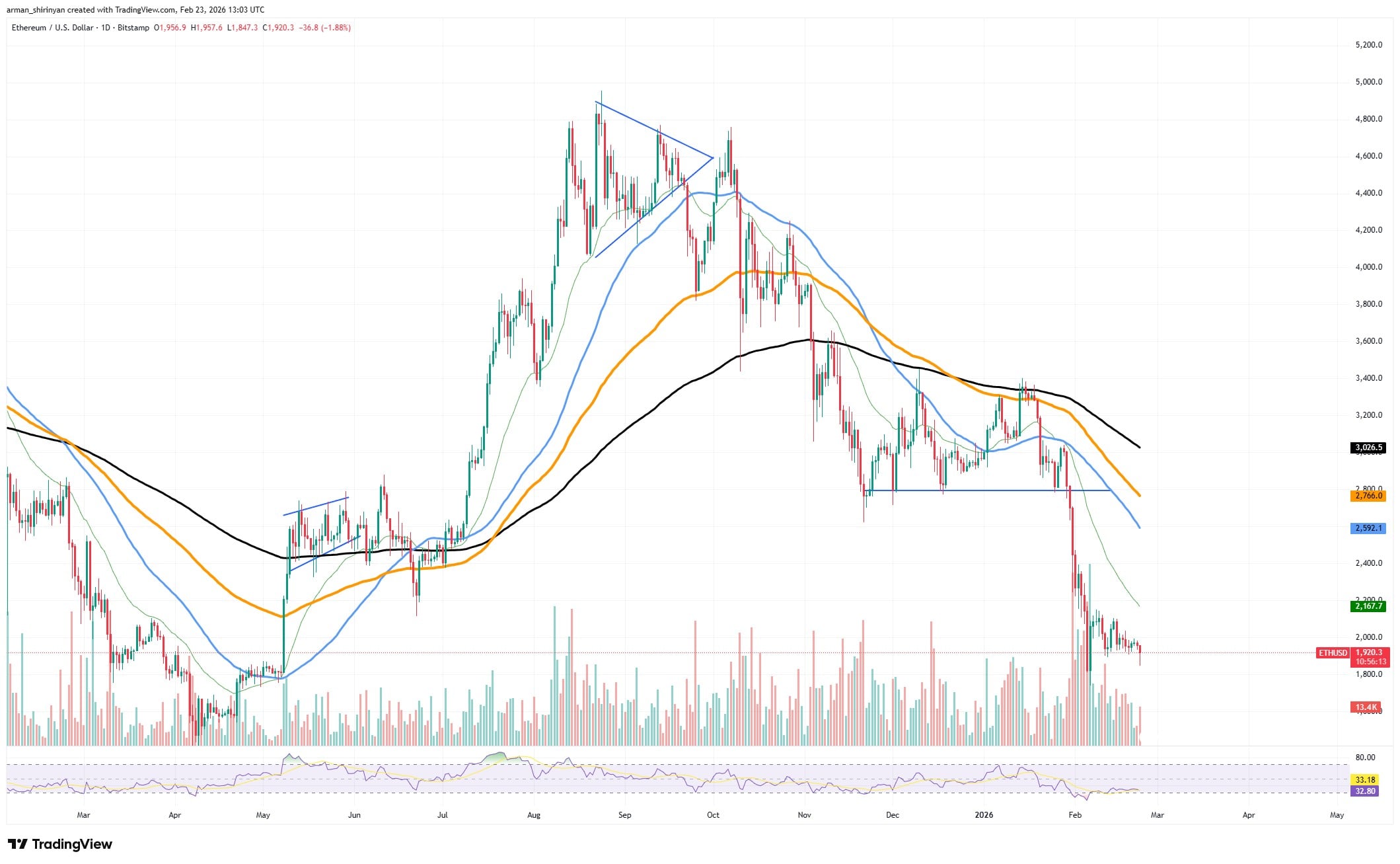
For this reason, the $1,885 level is particularly crucial. Currently, buyers are trying to establish a base in this support area. The market may steadily stabilize and start to form a stronger consolidation that could eventually support a recovery if Ethereum is able to maintain its position above this area. However, the technical structure would deteriorate even more and allow for another leg down if the price dropped sharply below it.
Patience and risk awareness are required in this situation. The market is still in a defensive phase, so until there is definitive confirmation, aggressive bullish positioning carries a higher risk. Ethereum regaining higher resistance zones and rising above short-term moving averages would be a more positive sign that momentum is changing.
Chances of XRP below $1
After years of consistent decline, XRP is currently trading in a precarious position, which begs the question of how realistic a move toward the $1 mark has become. With XRP sitting below its important moving averages and unable to produce significant recovery momentum, price action clearly displays a bearish structure. Every recent rebound has been followed by fresh selling, confirming that the overall trend continues to favor downward pressure.
Although XRP is currently trading above the mid-$1 region, lower highs are still forming, and the gap to $1 has progressively shrunk. The asset entered a defensive posture as a result of the breakdown from prior consolidation ranges, which accelerated selling and prevented short-lived rebounds from altering the overall structure.

Additionally, the chart demonstrates that XRP recently produced a minor stabilization attempt by reacting around a local support zone. Even though it has momentarily slowed the decline, the rebound is not as strong or as big as previous attempts. It is still possible that the price will veer lower once more and progressively test deeper supports if the surrounding resistance levels are not decisively reclaimed.
The main technical fact is that $1 is now distinct on both a structural and psychological level. Market pressure may inevitably push the price closer to that threshold if XRP keeps hitting lower lows and is unable to recover higher moving averages. Over time, persistent weakness raises the likelihood of a test, but a quick drop is not assured.
Being cautious is a sensible approach in this setting. As the asset continues to trade below significant resistance zones, XRP is still looking for a distinct base, and market confidence is still low. When price structure exhibits consistent downward continuation rather than reversal indicators, reevaluating risk exposure becomes more pertinent.
Shiba Inu challenged again
Shiba Inu is once again going through a challenging period, as evidenced by price action that shows a market still under a lot of strain and having trouble gaining traction. The overall structure is still bearish, and recent recovery attempts have not generated much movement. The fact that SHIB is forming tiny, brittle rebounds that quickly lose strength rather than a clean reversal indicates that sellers are still in control.
Technically speaking, the asset is still stuck below important moving averages, all of which are sloping lower and serving as dynamic resistance. SHIB is unable to establish long-term upward momentum whenever selling pressure returns, as the price gets close to these levels.
Although it provides short-term respite, the recent rise along a short ascending trend line, is part of a much longer downtrend that has been going on for months. The current bounce appears to be more of a pause than a genuine recovery, in this context.

The lack of strong buying conviction is what makes this time frame especially problematic. The majority of volume spikes occur during declines rather than rallies, indicating that market players are utilizing rebounds to limit exposure rather than to build up. This behavior often appears in prolonged corrective phases, where sentiment stays weak and confidence takes time to rebuild.
The unsettling fact is that given the circumstances, a speedy recovery appears doubtful. SHIB's outlook would change if the price were to break above several moving averages and reclaim higher resistance zones, both of which have so far proven unsuccessful. Without that confirmation, there is still a chance that the asset will continue to decline or, in the event that support falters, enter a new selling wave.
Additionally, things might get worse before getting better. When short-term traders sell their positions and momentum becomes even more negative, downside pressure may intensify if the current support trendline breaks. In that case, recovery expectations would be further delayed, and the larger bearish structure would be reinforced.
 U.Today Editorial Team
 Dan Burgin
