
Disclaimer: The opinions expressed by our writers are their own and do not represent the views of U.Today. The financial and market information provided on U.Today is intended for informational purposes only. U.Today is not liable for any financial losses incurred while trading cryptocurrencies. Conduct your own research by contacting financial experts before making any investment decisions. We believe that all content is accurate as of the date of publication, but certain offers mentioned may no longer be available.

Post-quantum cryptography is becoming a major focus across the blockchain industry as researchers prepare for the future threat of quantum computers. A new report from BNB Chain Research shows that the biggest challenge for blockchain networks may not be consensus systems, but the massive increase in transaction and block sizes caused by quantum-resistant signatures.
Migrating to post-quantum security
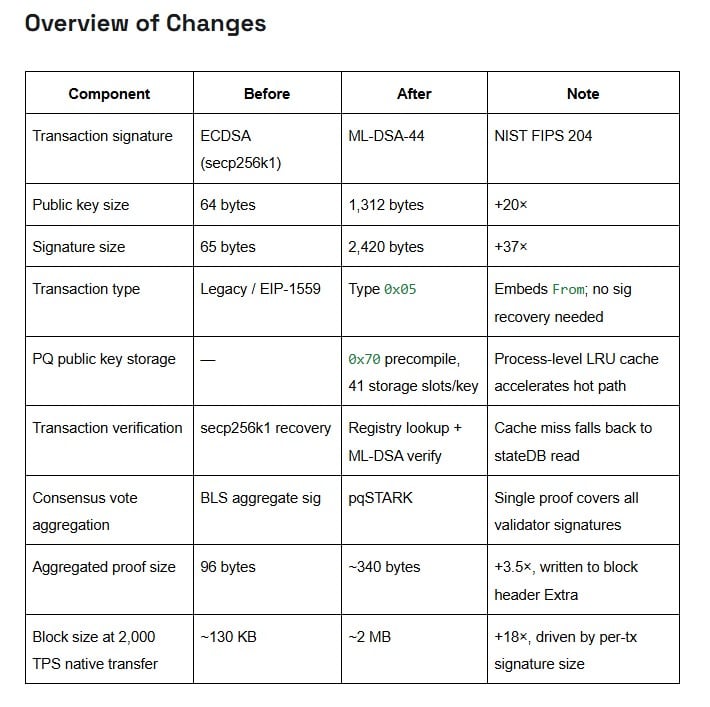
The research explored how BSC could migrate to post-quantum security using ML-DSA-44 transaction signatures and pqSTARK aggregation technology. The goal was to replace current cryptographic systems such as ECDSA and BLS, which could eventually become vulnerable to quantum attacks.
According to the report, post-quantum readiness is technically possible today. However, the trade-offs are significant.
Current blockchain transactions are relatively small, but quantum-resistant signatures are much larger. A normal transaction on BSC is around 110 bytes today. After switching to ML-DSA-44, the average transaction size increases to roughly 2.5 KB. Block sizes also jump from around 130 KB to nearly 2 MB under similar transaction loads.
Can throughtput issue be addressed?
This increase directly affects network performance. In testing, throughput dropped by around 40% to 50% because larger blocks take longer to propagate between nodes. Cross-region finality delays also increased, especially under heavy load.
Researchers said the main bottleneck was not the consensus mechanism itself. Consensus aggregation remained efficient thanks to pqSTARK compression, which reduced validator signature data by roughly 43 times. Instead, the biggest issue came from the network needing to move much larger amounts of data.

The report also explained why BNB researchers selected ML-DSA-44 instead of larger variants. The chosen version offers strong enough security while keeping signatures smaller and verification speeds faster, making it more practical for high-throughput blockchain environments.
For everyday users, there is no immediate danger. Quantum computers cannot currently break Bitcoin or BSC encryption in real-world conditions. The research is part of long-term preparation rather than an emergency response.
Still, the findings show that blockchains may eventually need major infrastructure upgrades to handle the data demands of post-quantum cryptography while maintaining speed and scalability.
 Dan Burgin
 U.Today Editorial Team
