

Disclaimer: The opinions expressed by our writers are their own and do not represent the views of U.Today. The financial and market information provided on U.Today is intended for informational purposes only. U.Today is not liable for any financial losses incurred while trading cryptocurrencies. Conduct your own research by contacting financial experts before making any investment decisions. We believe that all content is accurate as of the date of publication, but certain offers mentioned may no longer be available.

Shiba Inu is starting to show the first signs of stabilization after an extended downtrend, and the latest on-chain data backs that up. Exchange inflows (MA7) dropping by roughly 47% is not a small shift, it directly points to a cooling of sell-side pressure.
Donwside driver disappears
Fewer tokens moving onto exchanges typically means fewer participants are preparing to dump, which removes one of the main drivers behind persistent downside.
At the same time, total exchange inflow is only marginally up, while outflows are slightly stronger. Net flow remains negative, indicating that more SHIB is leaving exchanges than entering. That's a subtle but important change in structure. It suggests that, at least in the short term, holders are stepping away from distribution and leaning more toward holding or repositioning.
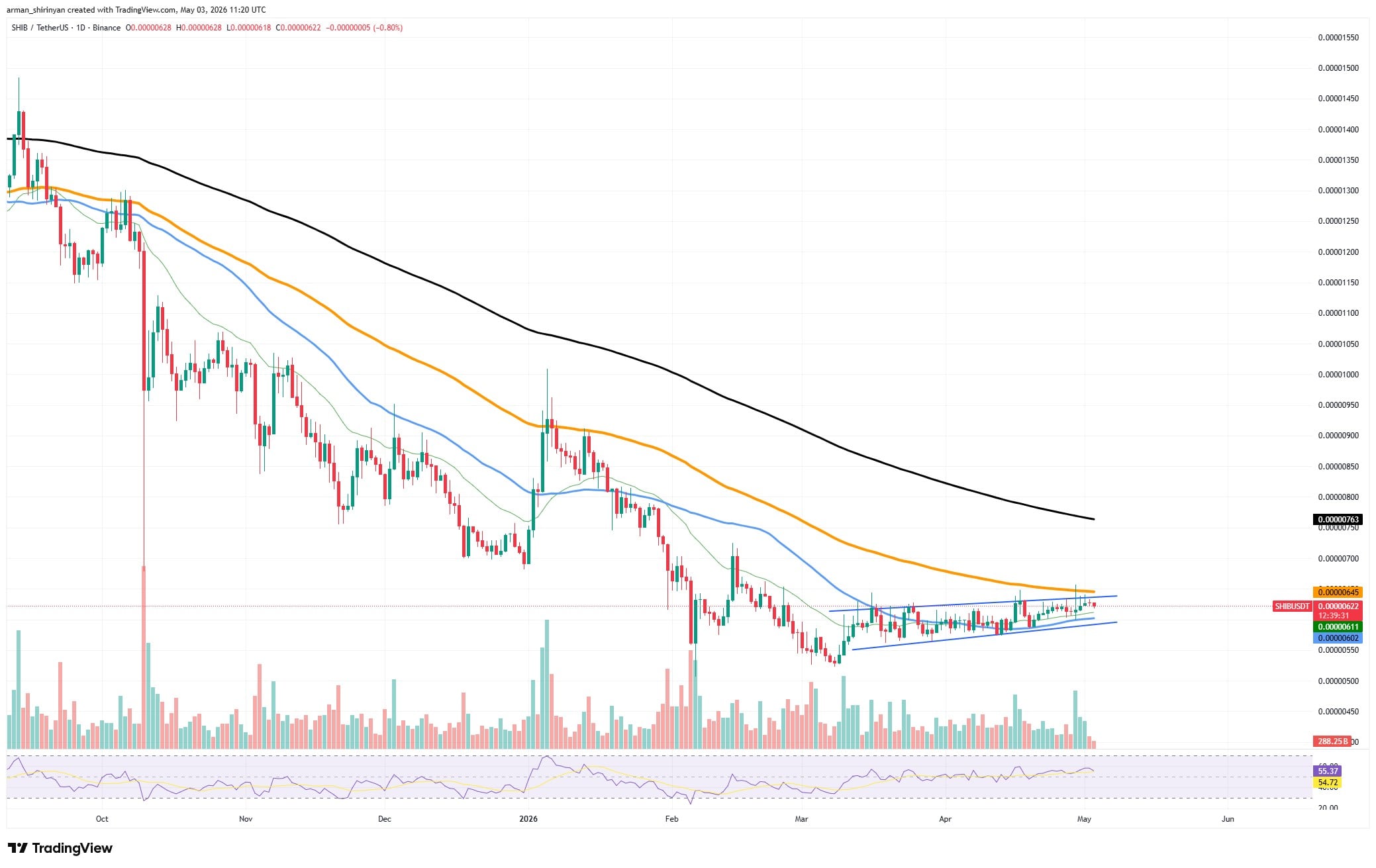
On the chart, this lines up with what price is doing. SHIB has been forming a tight ascending channel, gradually printing higher lows since the February bottom. The asset is slowly pushing upward toward the 100 EMA, which has acted as a consistent ceiling throughout the broader downtrend.
That's where things get tricky.
Even with reduced selling pressure, SHIB is still trading below major trend-defining levels. The 50 and 100 EMAs are still overhead, and the 200 EMA is far above, reinforcing that the macro structure hasn't flipped.

The drop in inflows lowers immediate downside risk, but it doesn't automatically translate into upside momentum. For a real breakout, SHIB needs demand expansion, not just reduced selling. So far, volume remains relatively muted, which suggests buyers are cautious rather than committed.
What to anticipate next is a test of resistance near the upper boundary of the ascending channel and the 100 EMA. If SHIB manages to break and hold above that zone, the move could extend toward the next resistance cluster around the 200 EMA.
If it fails there, the likely outcome is more sideways compression or a pullback toward the lower trendline. Bottom line: selling pressure is easing, but buyers haven't taken control yet. This is a transition phase, not a confirmed reversal.
 Dan Burgin
 U.Today Editorial Team
