

Disclaimer: The opinions expressed by our writers are their own and do not represent the views of U.Today. The financial and market information provided on U.Today is intended for informational purposes only. U.Today is not liable for any financial losses incurred while trading cryptocurrencies. Conduct your own research by contacting financial experts before making any investment decisions. We believe that all content is accurate as of the date of publication, but certain offers mentioned may no longer be available.

Following the rapid disappearance of nearly 500 billion SHIB from centralized exchange reserves, Shiba Inu is exhibiting an unexpected change in on-chain behavior.
Shiba Inu reserves thinning out
Recent exchange flow metrics show that netflows turned sharply negative, indicating that more tokens are leaving exchanges than entering them, while total SHIB reserves on exchanges fell toward the 81.2 trillion range. This is significant because exchange reserves serve as a proxy for instantaneous sell-side liquidity.
Reduced short-term selling intent is typically indicated when significant amounts of SHIB shift from exchanges into private wallets, cold storage, or staking-related infrastructure. Practically speaking, there is less instantly available supply for aggressive distribution or panic selling when there are fewer coins on trading platforms.
The most recent metrics support that story. While total netflow remained significantly negative at more than -430 billion SHIB, exchange reserve balances fell by about 0.5%. Exchange outflows surpassed inflows at the same time, indicating that whales and larger holders are actively removing tokens, rather than preparing to sell their holdings.
Shiba Inu's status is improving
Despite the negative sentiment in the market, active address growth continued to be positive, indicating that network participation has not declined. This contrasts intriguingly with the recent market structure of SHIB. A few weeks prior, analysts were cautioning about growing exchange reserves close to the crucial 81 trillion threshold, claiming that an increase in supply on exchanges raised the possibility of another sell-off wave. The trend now seems to be stabilizing in the other direction.

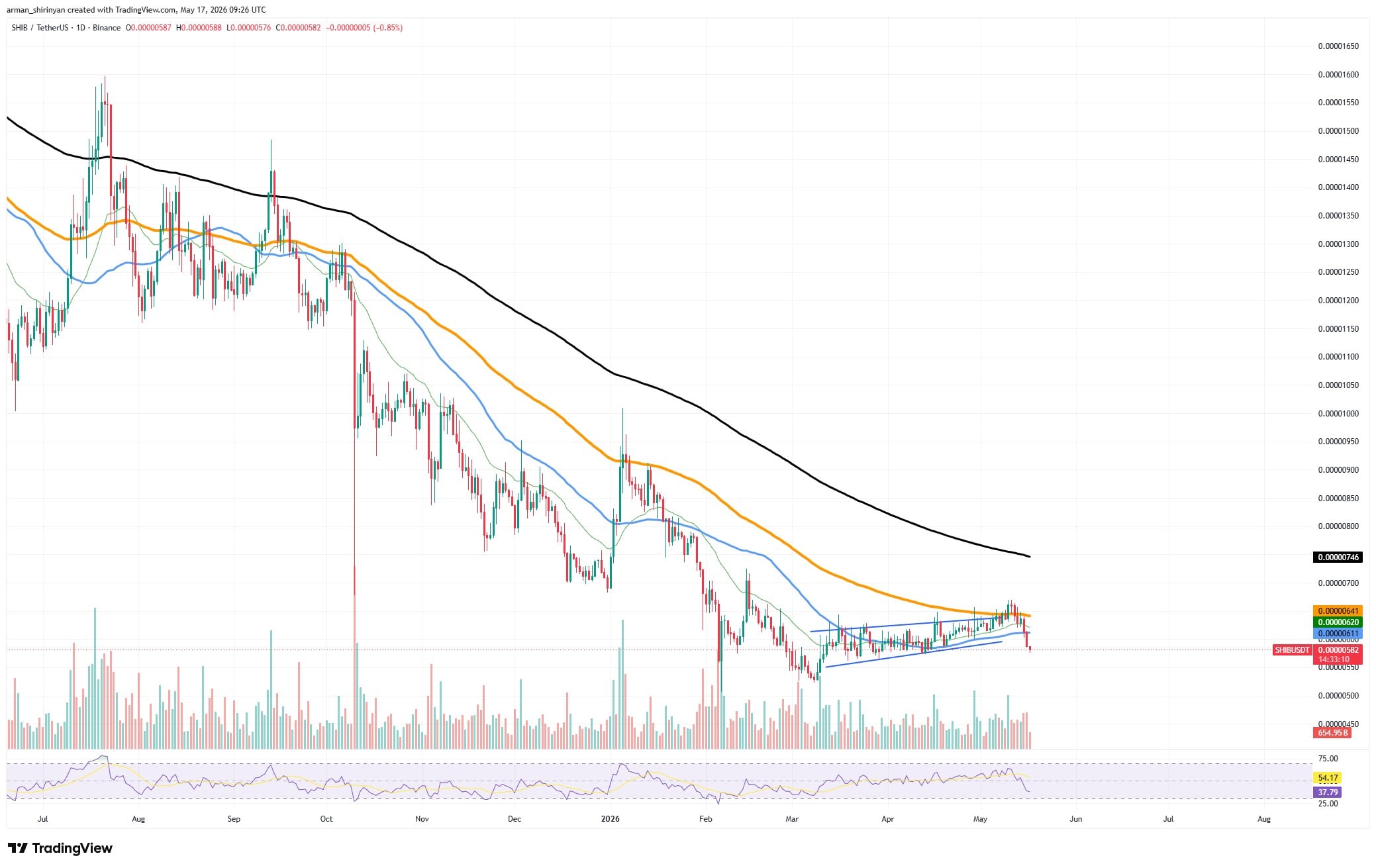
The chart depicts that transition phase. For the majority of the previous year, SHIB was stuck in a steady decline below all major moving averages. On the other hand, the token developed a rising support structure with progressively higher lows in March and April. As the price repeatedly tested resistance between $0.0000063 and $0.0000064, it compressed inside an ascending triangle.
Short-term momentum was weakened by the most recent rejection from resistance, and SHIB has since fallen back below the local support trendline. Following the unsuccessful attempt at a breakout, RSI also rolled over into bearish territory, indicating that momentum had significantly decreased.
That puts SHIB in a precarious situation from a technical standpoint. However, the overall situation is not entirely pessimistic. Long-term holders may still be accumulating, or at the very least refusing to distribute aggressively at current prices, based on the decline in exchange reserves.
The market may attempt another breakout later this quarter if SHIB can stabilize above the $0.0000057–$0.0000058 zone and regain resistance close to $0.0000063. As of right now, SHIB is caught between two opposing forces: improving on-chain supply dynamics and weakening short-term price momentum. The token's next significant move will probably depend on which force prevails.
 Dan Burgin
