

Disclaimer: The opinions expressed by our writers are their own and do not represent the views of U.Today. The financial and market information provided on U.Today is intended for informational purposes only. U.Today is not liable for any financial losses incurred while trading cryptocurrencies. Conduct your own research by contacting financial experts before making any investment decisions. We believe that all content is accurate as of the date of publication, but certain offers mentioned may no longer be available.

The fact that Bitcoin fell below the $70,000 mark is more significant than the level itself: it affects the rest of the market, as XRP dropped below the crucial bullish threshold. Assets like LINK also lost a major portion of their value but might have something up their sleeve.
Gradual pressure on Bitcoin
The breakdown did not occur suddenly. For weeks, Bitcoin has been declining, printing a series of lower highs and continuously failing to regain important moving averages. Every attempt at a rally has stalled beneath the 50 EMA, which has served as a ceiling.
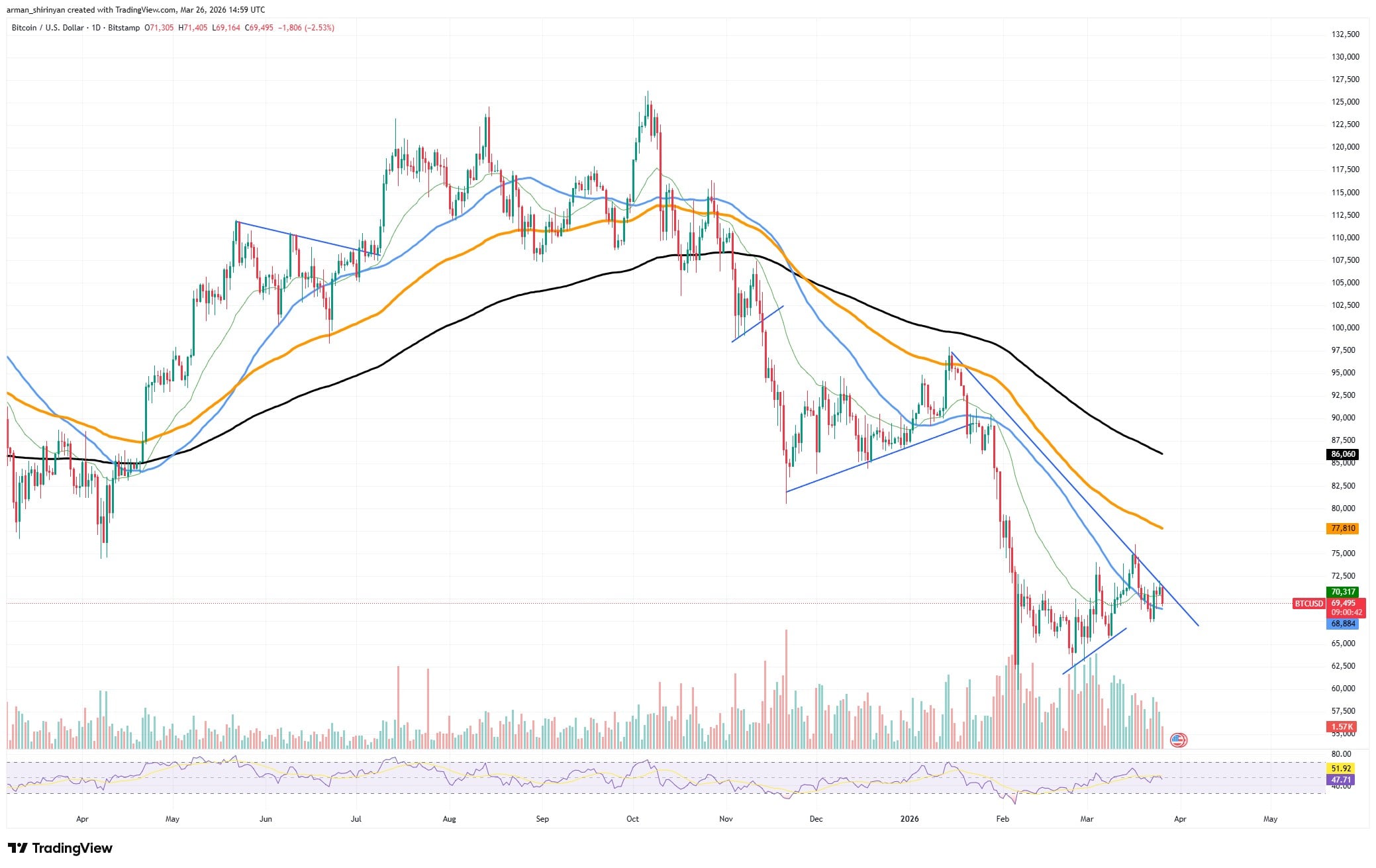
Long before the actual $70,000 loss, that structure indicated weakness, and the recent decline only served to confirm that sellers are still in charge.
After the collapse, Bitcoin is currently making an effort to stabilize, but the recovery is unconvincing. Just below the previous support, which has now turned into resistance, the price is compressing in a small range. This type of behavior is common following a breakdown, when the market hesitates before attempting a recovery or continuing lower.
Next obvious levels for BTC
From a structural standpoint, the next levels are rather obvious. To change short-term momentum, Bitcoin must recover and hold the $70,000-$72,000 range, which is immediate resistance. Above that, the 50 EMA continues to be the crucial obstacle that needs to be overcome in order for a significant recovery to begin.

On the downside, lower support zones in the mid-$60,000 range become accessible if $70,000 is not recovered. The chart indicates that there is not much strong support between the current levels and that region, which raises the possibility that selling pressure will continue.
Although it is contingent, recovery is still achievable. Bitcoin must maintain higher lows and rebound above lost support, not merely experience a brief surge. Any upward move in the absence of that is probably just another relief rally inside a larger downtrend.
The structure, as it stands, does not support an immediate bullish continuation. It represents a market that is attempting to regain stability following the loss of a crucial level.
Chainlink's prospects
Although Chainlink is beginning to stabilize, the overall structure is still bearish, and this contradiction characterizes the current situation.
For months, LINK has been in a definite downward trend, continuously trading below its important moving averages and failing to maintain any significant rallies. The price is still compressed below the 50, 100 and 200 EMAs, which are all trending downward. By itself, it maintains the asset's bearish regime, in which upward movements are viewed as corrective rather than impulsive.

The behavior around local laws has recently changed. LINK has begun creating a horizontal base slightly above the $8-$9 range, rather than continuing to print lower lows. Volatility has decreased, and selling pressure has lessened, indicating that the market is no longer actively driving down prices.
Technically speaking, a move toward $10 makes sense, but it completely depends on recovering short-term resistance. The first significant barrier is the 50 EMA, which is located slightly above the current price.
In line with previous consolidation areas and psychological resistance, the path toward the $10 level will open as the next logical resistance zone if LINK is able to break above it and hold.
XRP's trend breaks
The larger picture indicates that XRP’s decline toward a crucial support area close to $1.20 is not merely a transient oscillation but rather a component of a declining trend.
The price action has been steadily declining. XRP lost what little bullish structure it had and started printing lower highs again after failing to recover the 50 EMA. The idea that buyers are powerless was reinforced by the recent bounce attempt, which was weak and swiftly absorbed. The structure appears more and more susceptible to a breakdown, and the rising support line that momentarily kept the market together is now under pressure.
Things are getting worse
The degree to which on-chain deterioration is closely correlated with price is what makes the situation more alarming. Both transaction volume and active participation have significantly decreased over the same time period on XRP Ledger.
This parallel movement is significant because it implies that the weakness is a result of decreased network engagement, rather than just price action. A lack of underlying demand is usually indicated when the price decreases in tandem with declining network activity.

This is not a situation where the asset is momentarily undervalued while the fundamentals are still solid. Rather than expanding, both layers are traveling in the same direction, indicating contraction. There is not much support for long-term gains if network usage does not rebound.
Short-term bounces in XRP are more likely to be corrective actions within a larger downtrend than to signal the beginning of a significant reversal. Now, it is important to keep an eye on the $1.20 level. There is little structural support right below that zone, so if the price approaches it once more and is unable to hold, the market may continue to decline.
 U.Today Editorial Team
 Dan Burgin
